Sonar
Sonar (originally an acronym for SOund Navigation And Ranging) is a technique that uses sound propagation (usually underwater, as in submarine navigation) to navigate, communicate with or detect objects on or under the surface of the water, such as other vessels. Two types of technology share the name "sonar": passive sonar is essentially listening for the sound made by vessels; active sonar is emitting pulses of sounds and listening for echoes. Sonar may be used as a means of acoustic location and of measurement of the echo characteristics of "targets" in the water. Acoustic location in air was used before the introduction of radar. Sonar may also be used in air for robot navigation, and SODAR (an upward-looking in-air sonar) is used for atmospheric investigations. The term sonar is also used for the equipment used to generate and receive the sound. The acoustic frequencies used in sonar systems vary from very low (infrasonic) to extremely high (ultrasonic).
History[edit]
The development of sonar began in the early 20th century, primarily as a response to the sinking of the Titanic in 1912. Early efforts were aimed at creating an iceberg detector. During World War I, the need for submarine detection led to further development and the first practical systems. The technology advanced rapidly during World War II, leading to the widespread adoption of sonar in submarines and surface ships.
Types of Sonar[edit]
Active Sonar[edit]
Active sonar systems emit an acoustic signal or pulse of sound into the water. If an object is in the path of the sound pulse, the sound bounces back to the sonar transducer, which converts the sound waves into electrical signals that can be interpreted to determine the distance, speed, and shape of the object.
Passive Sonar[edit]
Passive sonar systems do not emit their own signal, which makes them less detectable. Instead, they listen for sounds made by vessels or marine life in the water. This method is often used in military applications to avoid detection.
Applications[edit]
Sonar is used in a variety of applications, including navigation, fishing, underwater exploration, and military uses. In navigation, sonar systems can map the ocean floor, detect obstacles, and aid in the docking of ships. In fishing, sonar is used to locate schools of fish. Military applications include submarine navigation and detection, mine detection, and anti-submarine warfare.
Environmental Impact[edit]
The use of sonar, especially active sonar, can have detrimental effects on marine life. The high-intensity sound pulses can cause hearing loss in marine mammals, disorient fish, and even lead to the stranding of whales. Environmental organizations and some governments have called for restrictions on sonar use to protect marine life.
See Also[edit]
- Underwater acoustics
- Hydroacoustics
- Submarine warfare
- Echo sounding
- Acoustic homing
- Marine mammals and sonar
References[edit]

-
 Motte-Picquet tugged sonar
 -
 Miinitraaleri "Virsaitis" vrakk
 -
 ASDIC
ASDIC -
 Sonar Principle EN
 -
 Undersea bubble clouds
 -
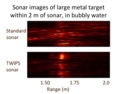 TWIPS picture 2
 -
 Variabel dybde sonar (VDS) på et af søværnets skibe af Thetis-klassen
 -
 SH-3H HS-15 lowers AQS-13 sonar 1979
 -
 Watch floor
 -
 US Navy 030223-N-7479T-011 An AN-PQS-2A, a handheld sonar device used to aid in the search of the Toledo Bend Reservoir for debris from the Space Shuttle Columbia
 -
 Fishfinder
 -
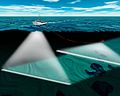 Sonar operations by survey ship


_p%C3%A5_et_af_s%C3%B8v%C3%A6rnets_skibe_af_Thetis-klassen.jpg)


Ad. Transform your health with W8MD Weight Loss, Sleep & MedSpa

Tired of being overweight?
Special offer:
Budget GLP-1 weight loss medications
- Semaglutide starting from $29.99/week and up with insurance for visit of $59.99 and up per week self pay.
- Tirzepatide starting from $45.00/week and up (dose dependent) or $69.99/week and up self pay
✔ Same-week appointments, evenings & weekends
Learn more:
- GLP-1 weight loss clinic NYC
- W8MD's NYC medical weight loss
- W8MD Philadelphia GLP-1 shots
- Philadelphia GLP-1 injections
- Affordable GLP-1 shots NYC
|
WikiMD Medical Encyclopedia |
Medical Disclaimer: WikiMD is for informational purposes only and is not a substitute for professional medical advice. Content may be inaccurate or outdated and should not be used for diagnosis or treatment. Always consult your healthcare provider for medical decisions. Verify information with trusted sources such as CDC.gov and NIH.gov. By using this site, you agree that WikiMD is not liable for any outcomes related to its content. See full disclaimer.
Credits:Most images are courtesy of Wikimedia commons, and templates, categories Wikipedia, licensed under CC BY SA or similar.
Translate this page: - East Asian
中文,
日本,
한국어,
South Asian
हिन्दी,
தமிழ்,
తెలుగు,
Urdu,
ಕನ್ನಡ,
Southeast Asian
Indonesian,
Vietnamese,
Thai,
မြန်မာဘာသာ,
বাংলা
European
español,
Deutsch,
français,
Greek,
português do Brasil,
polski,
română,
русский,
Nederlands,
norsk,
svenska,
suomi,
Italian
Middle Eastern & African
عربى,
Turkish,
Persian,
Hebrew,
Afrikaans,
isiZulu,
Kiswahili,
Other
Bulgarian,
Hungarian,
Czech,
Swedish,
മലയാളം,
मराठी,
ਪੰਜਾਬੀ,
ગુજરાતી,
Portuguese,
Ukrainian
