Seat belt
Seat belt (also known as a safety belt) is a vehicle safety device designed to secure the driver or a passenger of a vehicle against harmful movement that may result during a collision or a sudden stop.
History[edit]
The first patent for the use of seat belts was issued to Edward J. Claghorn of New York, United States on February 10, 1885. Nils Bohlin, a Swedish inventor working for Volvo, designed the modern three-point seat belt in 1959.
Design[edit]
Seat belts are designed to retain people in their seats, and so prevent or reduce injuries suffered in a crash. They ensure that as little contact is made between the occupant and vehicle interior as possible and significantly reduce the risk in a crash.
Three-point seat belt[edit]
The three-point seat belt was developed to protect car occupants from injury in a crash, particularly in a high impact crash. The three-point seat belt is a combination of a lap belt and a sash belt, providing restraint to the upper and lower body.
Effectiveness[edit]
Seat belts are one of the most effective means of saving lives and reducing injuries in crashes. They reduce the risk of death for front seat passengers by 45% and the risk of serious injury by 50%.
Legislation[edit]
Many countries have made it mandatory for vehicle occupants to wear seat belts. The first mandatory seat belt law was put into effect in Victoria, Australia in 1970.
See also[edit]
References[edit]
<references />
 | |
|---|---|
 |
 |
Seat_belt[edit]
-
 Female driver buckling seatbelt
 -
 Lives Saved by Safety Belts and Air Bags, NHTSA, DOT
 -
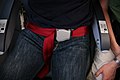 Airplane seat belt
 -
 Seat belt BX
 -
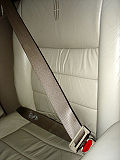 Seatbelt
 -
 Bucket seat with Schroth six-point harness in a 2010 Porsche 997 GT3 RS 3.8
 -
 Inertial reel
 -
 Gurtstraffer
 -
 1990 Honda Civic DX interior
 -
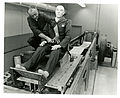 Seatbelt testing apparatus
 -
 Child car seat
 -
 11 ceintures


Ad. Transform your life with W8MD's
GLP-1 weight loss injections special from $29.99 with insurance
|
WikiMD Medical Encyclopedia |
Medical Disclaimer: WikiMD is for informational purposes only and is not a substitute for professional medical advice. Content may be inaccurate or outdated and should not be used for diagnosis or treatment. Always consult your healthcare provider for medical decisions. Verify information with trusted sources such as CDC.gov and NIH.gov. By using this site, you agree that WikiMD is not liable for any outcomes related to its content. See full disclaimer.
Credits:Most images are courtesy of Wikimedia commons, and templates, categories Wikipedia, licensed under CC BY SA or similar.
Translate this page: - East Asian
中文,
日本,
한국어,
South Asian
हिन्दी,
தமிழ்,
తెలుగు,
Urdu,
ಕನ್ನಡ,
Southeast Asian
Indonesian,
Vietnamese,
Thai,
မြန်မာဘာသာ,
বাংলা
European
español,
Deutsch,
français,
Greek,
português do Brasil,
polski,
română,
русский,
Nederlands,
norsk,
svenska,
suomi,
Italian
Middle Eastern & African
عربى,
Turkish,
Persian,
Hebrew,
Afrikaans,
isiZulu,
Kiswahili,
Other
Bulgarian,
Hungarian,
Czech,
Swedish,
മലയാളം,
मराठी,
ਪੰਜਾਬੀ,
ગુજરાતી,
Portuguese,
Ukrainian
