Enzyme kinetics
Enzyme kinetics is the study of the chemical reactions that are catalyzed by enzymes. In enzyme kinetics, the reaction rate is measured and the effects of varying the conditions of the reaction are investigated. Studying an enzyme's kinetics in this way can reveal the catalytic mechanism of this enzyme, its role in metabolism, how its activity is controlled, and how a drug or an agonist might inhibit the enzyme.
Introduction[edit]
Enzymes are molecules that manipulate other molecules — the enzymes' substrates. These target molecules bind to an enzyme's active site and are transformed into products through a series of steps known as the enzymatic catalytic cycle. Enzymes can catalyze up to several million reactions per second. Enzyme rates depend on solution conditions and substrate concentration.
Enzyme Kinetic Models[edit]
Michaelis-Menten Kinetics[edit]
The Michaelis-Menten model is the one of the simplest and best-known approaches to enzyme kinetics. It takes the name from Leonor Michaelis and Maud Menten. This kinetic model is valid when the assumption of steady state can be made, which is that the concentration of the enzyme-substrate complex (ES) is constant over time.
Briggs-Haldane Kinetics[edit]
The Briggs-Haldane model is derived from the quasi-steady-state approximation (QSSA). The QSSA assumes that a quasi-steady state is formed in which the rate of formation of ES is equal to the rate of its consumption.
Hill Kinetics[edit]
Hill kinetics is used when the substrate can bind more than one enzyme at a time. It is a special case of the general equations given above. It was first introduced by Archibald Hill.
Factors Affecting Enzyme Activity[edit]
Enzyme activity can be affected by a variety of factors, such as temperature, pH, and concentration. Enzymes work best within specific temperature and pH ranges, and sub-optimal conditions can cause an enzyme to lose its ability to bind to a substrate.
Inhibition[edit]
Enzyme inhibitors are molecules that bind to enzymes and decrease their activity. Since blocking an enzyme's activity can kill a pathogen or correct a metabolic imbalance, many drugs are enzyme inhibitors.
See Also[edit]
References[edit]
.svg)
This article is a biochemistry stub. You can help WikiMD by expanding it!
Enzyme_kinetics[edit]
-
 EcDHFR raytraced
 -
 KinEnzymo (en)
 -
 Enzyme progress curve
 -
 Enzyme mechanism 2
 -
 Michaelis Menten curve 2
 -
 Lineweaver-Burke plot
 -
 Enzyme Kinetics
 -
 Random order ternary mechanism
 -
 Allosteric v by S curve
 -
 Burst phase
 -
 Reversible inhibition
 -
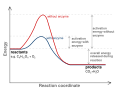 Activation2 updated

.svg)


Ad. Transform your health with W8MD Weight Loss, Sleep & MedSpa

Tired of being overweight?
Special offer:
Budget GLP-1 weight loss medications
- Semaglutide starting from $29.99/week and up with insurance for visit of $59.99 and up per week self pay.
- Tirzepatide starting from $45.00/week and up (dose dependent) or $69.99/week and up self pay
✔ Same-week appointments, evenings & weekends
Learn more:
- GLP-1 weight loss clinic NYC
- W8MD's NYC medical weight loss
- W8MD Philadelphia GLP-1 shots
- Philadelphia GLP-1 injections
- Affordable GLP-1 shots NYC
|
WikiMD Medical Encyclopedia |
Medical Disclaimer: WikiMD is for informational purposes only and is not a substitute for professional medical advice. Content may be inaccurate or outdated and should not be used for diagnosis or treatment. Always consult your healthcare provider for medical decisions. Verify information with trusted sources such as CDC.gov and NIH.gov. By using this site, you agree that WikiMD is not liable for any outcomes related to its content. See full disclaimer.
Credits:Most images are courtesy of Wikimedia commons, and templates, categories Wikipedia, licensed under CC BY SA or similar.
Translate this page: - East Asian
中文,
日本,
한국어,
South Asian
हिन्दी,
தமிழ்,
తెలుగు,
Urdu,
ಕನ್ನಡ,
Southeast Asian
Indonesian,
Vietnamese,
Thai,
မြန်မာဘာသာ,
বাংলা
European
español,
Deutsch,
français,
Greek,
português do Brasil,
polski,
română,
русский,
Nederlands,
norsk,
svenska,
suomi,
Italian
Middle Eastern & African
عربى,
Turkish,
Persian,
Hebrew,
Afrikaans,
isiZulu,
Kiswahili,
Other
Bulgarian,
Hungarian,
Czech,
Swedish,
മലയാളം,
मराठी,
ਪੰਜਾਬੀ,
ગુજરાતી,
Portuguese,
Ukrainian
