Rotifer
Rotifer
The Rotifer (also known as wheel animalcules) are a phylum of microscopic and near-microscopic pseudocoelomate animals. They were first described by Rev. John Harris in 1696, and later by Antonie van Leeuwenhoek in 1703. Rotifers are part of the supergroup Spiralia, an ancient and diverse group of animals.
Classification[edit]
Rotifers belong to the kingdom Animalia, the phylum Rotifera, and the class Eurotatoria. There are around 2200 species of rotifers, grouped into two classes: the Monogononta, which have one gonad and the Bdelloidea and Seisonidea, which have two gonads.
Anatomy[edit]
Rotifers are bilaterally symmetrical and have a variety of different shapes. The head of a rotifer is called the corona, which is ciliated and creates a current that brings food into the mouth. Rotifers have a simple digestive system with a mouth, stomach, and cloaca. They also have a simple nervous system with a brain and two longitudinal nerve cords.
Reproduction[edit]
Rotifers reproduce through both sexual and asexual reproduction. In sexual reproduction, males are haploid and females are diploid. In asexual reproduction, females produce offspring from unfertilized eggs, a process known as parthenogenesis.
Ecology[edit]
Rotifers are found in many freshwater environments and in moist soil, where they inhabit the thin films of water that surround the soil particles. They eat particles up to 10 micrometres in size, including bacteria, algae, and protozoans.
See also[edit]
References[edit]
<references />
External links[edit]
- Rotifers - Microscopy UK
 | |
|---|---|
 |
 |
-
 Mikrofoto.de Raedertier 14
 -
 Pulchritia dorsicornuta - ZooKeys 342 001 g001
 -
 Figure 28 03 05
 -
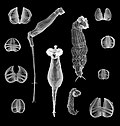 Bdelloid
 -
 20100708 colonial rotifer Conochilius
 -
 Sinantheria socialis
 -
 Philodina rugosa 756859
 -
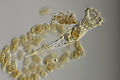 Mikrofoto.de Raedertier Ptygura pilula 2
 -
 Mikrofoto.de Brachionus quadridentatus 6
 -
 Movie of Rotifer, feeding (probably of the genus Cephalodella)
 -
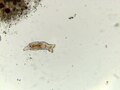 Feeding rotifer
 -
 Pair of Rotifers, likely Euchlanis, from Northeast US Pond sample


Ad. Transform your health with W8MD Weight Loss, Sleep & MedSpa

Tired of being overweight?
Special offer:
Budget GLP-1 weight loss medications
- Semaglutide starting from $29.99/week and up with insurance for visit of $59.99 and up per week self pay.
- Tirzepatide starting from $45.00/week and up (dose dependent) or $69.99/week and up self pay
✔ Same-week appointments, evenings & weekends
Learn more:
- GLP-1 weight loss clinic NYC
- W8MD's NYC medical weight loss
- W8MD Philadelphia GLP-1 shots
- Philadelphia GLP-1 injections
- Affordable GLP-1 shots NYC
|
WikiMD Medical Encyclopedia |
Medical Disclaimer: WikiMD is for informational purposes only and is not a substitute for professional medical advice. Content may be inaccurate or outdated and should not be used for diagnosis or treatment. Always consult your healthcare provider for medical decisions. Verify information with trusted sources such as CDC.gov and NIH.gov. By using this site, you agree that WikiMD is not liable for any outcomes related to its content. See full disclaimer.
Credits:Most images are courtesy of Wikimedia commons, and templates, categories Wikipedia, licensed under CC BY SA or similar.
Translate this page: - East Asian
中文,
日本,
한국어,
South Asian
हिन्दी,
தமிழ்,
తెలుగు,
Urdu,
ಕನ್ನಡ,
Southeast Asian
Indonesian,
Vietnamese,
Thai,
မြန်မာဘာသာ,
বাংলা
European
español,
Deutsch,
français,
Greek,
português do Brasil,
polski,
română,
русский,
Nederlands,
norsk,
svenska,
suomi,
Italian
Middle Eastern & African
عربى,
Turkish,
Persian,
Hebrew,
Afrikaans,
isiZulu,
Kiswahili,
Other
Bulgarian,
Hungarian,
Czech,
Swedish,
മലയാളം,
मराठी,
ਪੰਜਾਬੀ,
ગુજરાતી,
Portuguese,
Ukrainian
