German language
German language is a West Germanic language that is mainly spoken in Central Europe. It is the most widely spoken and official or co-official language in Germany, Austria, Switzerland, South Tyrol in Italy, the German-speaking Community of Belgium, and Liechtenstein. It is also one of the three official languages of Luxembourg and a co-official language in the Opole Voivodeship in Poland. The languages which are most similar to German are the other members of the West Germanic language branch: Afrikaans, Dutch, English, the Frisian languages, Low German/Low Saxon, Luxembourgish, and Yiddish. There are also strong similarities in vocabulary with Danish, Norwegian and Swedish, although those belong to the North Germanic group. German is the second most widely spoken Germanic language, after English.
History[edit]
The history of the German language begins with the High German consonant shift during the migration period, which separated Old High German dialects from Old Saxon. The earliest testimonies of Old High German are from scattered Elder Futhark inscriptions, especially in Alemannic, from the 6th century AD; the earliest glosses (Abrogans) date to the 8th; and the oldest coherent texts (the Hildebrandslied, the Muspilli and the Merseburg Incantations) to the 9th century.
Classification[edit]
German is a member of the West Germanic family of languages, which also includes English, Dutch, and several other languages that are now extinct. The Germanic languages are a branch of the larger Indo-European language family, which also includes, among others, the Celtic, Romance, and Baltic branches.
Geographic distribution[edit]
German is the main language of approximately 95 to 100 million people in Europe, or 13.3% of all Europeans, being the second most spoken native language in Europe after Russian, above French (66.5 million speakers in 2012) and English (64.2 million speakers in 2012).
Dialects[edit]
The dialects of German which are or were primarily spoken in colonies or communities founded by German-speaking people resemble the dialects of the regions the founders came from. For example, Hutterite German resembles dialects of Carinthia. Texas German is a dialect spoken in the areas of Texas settled by the Adelsverein, such as New Braunfels and Fredericksburg. In the Amana Colonies in the state of Iowa, Amana German is spoken.
Grammar[edit]
German is a highly inflected language with four cases for nouns, pronouns, and adjectives (nominative, accusative, genitive, dative), three genders (masculine, feminine, neuter), and strong and weak verbs. German derives the majority of its vocabulary from the ancient Germanic branch of the Indo-European language family.
Writing system[edit]
The German language uses the Latin script. In addition to the 26 standard letters, German has three vowels with Umlaut, namely ä, ö, and ü, as well as the Eszett or scharfes S (sharp s) which is written "ß".
See also[edit]
- Germanic languages
- High German languages
- Standard German
- German orthography
- German phonology
- German grammar
- History of German
 | |
|---|---|
 |
 |
German language[edit]
-
 Map of the German Diaspora in the World
 -
 WIKITONGUES: Gereon speaking German
 -
 Europe Germanic languages
 -
 Einteilung der Germanen nach Maurer
 -
 Germanic Languages Map Europe
 -
 Old Norse, ca 900
 -
 German dialect continuum in 1900 (according to Wiesinger & König)
 -
 Lutherbibel
 -
 HRR 1648
 -
 Austria Hungary ethnic
 -
 Meetings of German-speaking countries, participants
 -
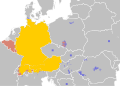 Legal status of German in Europe


.png)


Ad. Transform your health with W8MD Weight Loss, Sleep & MedSpa

Tired of being overweight?
Special offer:
Budget GLP-1 weight loss medications
- Semaglutide starting from $29.99/week and up with insurance for visit of $59.99 and up per week self pay.
- Tirzepatide starting from $45.00/week and up (dose dependent) or $69.99/week and up self pay
✔ Same-week appointments, evenings & weekends
Learn more:
- GLP-1 weight loss clinic NYC
- W8MD's NYC medical weight loss
- W8MD Philadelphia GLP-1 shots
- Philadelphia GLP-1 injections
- Affordable GLP-1 shots NYC
|
WikiMD Medical Encyclopedia |
Medical Disclaimer: WikiMD is for informational purposes only and is not a substitute for professional medical advice. Content may be inaccurate or outdated and should not be used for diagnosis or treatment. Always consult your healthcare provider for medical decisions. Verify information with trusted sources such as CDC.gov and NIH.gov. By using this site, you agree that WikiMD is not liable for any outcomes related to its content. See full disclaimer.
Credits:Most images are courtesy of Wikimedia commons, and templates, categories Wikipedia, licensed under CC BY SA or similar.
Translate this page: - East Asian
中文,
日本,
한국어,
South Asian
हिन्दी,
தமிழ்,
తెలుగు,
Urdu,
ಕನ್ನಡ,
Southeast Asian
Indonesian,
Vietnamese,
Thai,
မြန်မာဘာသာ,
বাংলা
European
español,
Deutsch,
français,
Greek,
português do Brasil,
polski,
română,
русский,
Nederlands,
norsk,
svenska,
suomi,
Italian
Middle Eastern & African
عربى,
Turkish,
Persian,
Hebrew,
Afrikaans,
isiZulu,
Kiswahili,
Other
Bulgarian,
Hungarian,
Czech,
Swedish,
മലയാളം,
मराठी,
ਪੰਜਾਬੀ,
ગુજરાતી,
Portuguese,
Ukrainian
