Resonance
Resonance is a phenomenon that occurs in many different scientific fields, but it always involves systems that oscillate at certain frequencies. In simple terms, resonance occurs when a system is able to store and easily transfer energy between two or more different storage modes (such as kinetic energy and potential energy in the case of a pendulum). However, there are some slight differences in how resonance is described in various fields of study.
Physics[edit]
In physics, resonance is the phenomenon that occurs when a vibrating system or external force drives another system to oscillate with greater amplitude at specific frequencies. Frequencies at which the response amplitude is a relative maximum are known as the system's resonant frequencies or resonance frequencies. At these frequencies, even small periodic driving forces can produce large amplitude oscillations, because the system stores vibrational energy.
Chemistry[edit]
In chemistry, resonance is a way of describing delocalized electrons within certain molecules or polyatomic ions where the bonding cannot be expressed by one single Lewis structure. Instead, a molecule or ion is described as a composite of several contributing structures (or resonance structures) representing the extremes of electron locations.
Electrical Engineering[edit]
In electrical engineering, resonance occurs in an electric circuit at a particular resonant frequency when the impedance of the circuit is at its minimum (series resonance) or its maximum (parallel resonance).
Medicine[edit]
In medicine, resonance refers to the sound the human body produces when air is blown through certain body structures, such as the lungs. This is used in the diagnosis of various health conditions.
Music[edit]
In music, resonance amplifies the sound in musical instruments in such a way that a small input of energy can maintain a large vibration. This is the principle behind many wind and string instruments.
See Also[edit]
 | |
|---|---|
 |
 |
Resonance[edit]
-
 Resonance
 -
 Little girl on swing
 -
 Mplwp resonance zeta envelope
 -
 Rajz RLC soros
 -
 RLC Series Circuit Bode Magnitude Plot
 -
 Animación1
 -
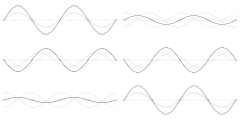 Standing wave 2
 -
 Standing waves on a string
 -
 Resonating mass experiment
 -
 Tuned circuit animation 3
 -
 HWB-NMR - 900MHz - 21.2 Tesla
 -
 High and low Q factor


Ad. Transform your health with W8MD Weight Loss, Sleep & MedSpa

Tired of being overweight?
Special offer:
Budget GLP-1 weight loss medications
- Semaglutide starting from $29.99/week and up with insurance for visit of $59.99 and up per week self pay.
- Tirzepatide starting from $45.00/week and up (dose dependent) or $69.99/week and up self pay
✔ Same-week appointments, evenings & weekends
Learn more:
- GLP-1 weight loss clinic NYC
- W8MD's NYC medical weight loss
- W8MD Philadelphia GLP-1 shots
- Philadelphia GLP-1 injections
- Affordable GLP-1 shots NYC
|
WikiMD Medical Encyclopedia |
Medical Disclaimer: WikiMD is for informational purposes only and is not a substitute for professional medical advice. Content may be inaccurate or outdated and should not be used for diagnosis or treatment. Always consult your healthcare provider for medical decisions. Verify information with trusted sources such as CDC.gov and NIH.gov. By using this site, you agree that WikiMD is not liable for any outcomes related to its content. See full disclaimer.
Credits:Most images are courtesy of Wikimedia commons, and templates, categories Wikipedia, licensed under CC BY SA or similar.
Translate this page: - East Asian
中文,
日本,
한국어,
South Asian
हिन्दी,
தமிழ்,
తెలుగు,
Urdu,
ಕನ್ನಡ,
Southeast Asian
Indonesian,
Vietnamese,
Thai,
မြန်မာဘာသာ,
বাংলা
European
español,
Deutsch,
français,
Greek,
português do Brasil,
polski,
română,
русский,
Nederlands,
norsk,
svenska,
suomi,
Italian
Middle Eastern & African
عربى,
Turkish,
Persian,
Hebrew,
Afrikaans,
isiZulu,
Kiswahili,
Other
Bulgarian,
Hungarian,
Czech,
Swedish,
മലയാളം,
मराठी,
ਪੰਜਾਬੀ,
ગુજરાતી,
Portuguese,
Ukrainian
