Scuba diving
Scuba diving is a mode of underwater diving where the diver uses a self-contained underwater breathing apparatus (scuba), which is completely independent of surface supply, to breathe underwater. Scuba divers carry their own source of breathing gas, usually compressed air, allowing them greater independence and freedom of movement than surface-supplied divers, and longer underwater endurance than breath-hold divers.
History[edit]
The history of scuba diving is closely linked with the history of scuba equipment. By the turn of the twentieth century, two basic architectures for underwater breathing apparatus had been pioneered; open-circuit surface supplied equipment where the diver's exhaled gas is vented directly into the water, and closed-circuit breathing apparatus where the diver's carbon dioxide is filtered from the inhaled gas, which is then recirculated, which reduces the volume of breathing gas required.
Equipment[edit]
Scuba diving may be done recreationally or professionally in a number of applications, including scientific, military and public safety roles, but most commercial diving uses surface-supplied diving equipment when this is practicable. A scuba diver primarily moves underwater by using fins attached to the feet, but external propulsion can be provided by a diver propulsion vehicle, or a sled pulled from the surface.
Safety[edit]
Scuba diving is relatively high risk compared to many other sports, and requires good physical conditioning and attention to detail. Divers face specific physical and health risks in the water environment due to the scuba equipment itself, as well as the pressure and physiological changes that result from the depth and duration of the dive.
See also[edit]
 | |
|---|---|
 |
 |
Scuba_diving[edit]
-
 Buzo
Buzo -
 Scuba Diver
 -
 Naufragio por Gustavo Gerdel
 -
 Dykeri, fig 6, Nordisk familjebok
 -
 Henry Albert Fleuss
 -
 Aqualung
 -
 Sidemount 032 Photo by Pete Nawrocky
 -
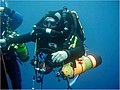 Trevor Jackson returns from SS Kyogle
 -
 Scuba Diver - Ahmad Faiz Mustafa
 -
 Diving regulator assembly
 -
 Plongee-Recycleur Inspiration
 -
 EANx Decal


.png)


Ad. Transform your health with W8MD Weight Loss, Sleep & MedSpa

Tired of being overweight?
Special offer:
Budget GLP-1 weight loss medications
- Semaglutide starting from $29.99/week and up with insurance for visit of $59.99 and up per week self pay.
- Tirzepatide starting from $45.00/week and up (dose dependent) or $69.99/week and up self pay
✔ Same-week appointments, evenings & weekends ✔ Tele visits available with certain limitations Learn more:
- GLP-1 weight loss clinic NYC
- W8MD's NYC medical weight loss
- W8MD Philadelphia GLP-1 shots
- Philadelphia GLP-1 injections
- Affordable GLP-1 shots NYC
- Budget GLP-1 shots
|
WikiMD Medical Encyclopedia |
Medical Disclaimer: WikiMD is for informational purposes only and is not a substitute for professional medical advice. Content may be inaccurate or outdated and should not be used for diagnosis or treatment. Always consult your healthcare provider for medical decisions. Verify information with trusted sources such as CDC.gov and NIH.gov. By using this site, you agree that WikiMD is not liable for any outcomes related to its content. See full disclaimer.
Credits:Most images are courtesy of Wikimedia commons, and templates, categories Wikipedia, licensed under CC BY SA or similar.
Translate this page: - East Asian
中文,
日本,
한국어,
South Asian
हिन्दी,
தமிழ்,
తెలుగు,
Urdu,
ಕನ್ನಡ,
Southeast Asian
Indonesian,
Vietnamese,
Thai,
မြန်မာဘာသာ,
বাংলা
European
español,
Deutsch,
français,
Greek,
português do Brasil,
polski,
română,
русский,
Nederlands,
norsk,
svenska,
suomi,
Italian
Middle Eastern & African
عربى,
Turkish,
Persian,
Hebrew,
Afrikaans,
isiZulu,
Kiswahili,
Other
Bulgarian,
Hungarian,
Czech,
Swedish,
മലയാളം,
मराठी,
ਪੰਜਾਬੀ,
ગુજરાતી,
Portuguese,
Ukrainian
