Sequence alignment
Sequence alignment is a method used in bioinformatics to arrange the sequences of DNA, RNA, or protein to identify regions of similarity. These similarities may be a result of functional, structural, or evolutionary relationships between the sequences. Aligned sequences of nucleotide or amino acid residues are typically represented as rows within a matrix. Gaps are inserted between the sequences to optimize the alignment and to identify the conservation and changes in different molecular sequences.
Types of Sequence Alignment[edit]
There are two main types of sequence alignment: global alignment and local alignment.
Global alignment, implemented in the Needleman-Wunsch algorithm, compares the entire sequence of two entities and is most useful when the sequences are of roughly equal length and are quite similar.
Local alignment, implemented in the Smith-Waterman algorithm, identifies regions of similarity within long sequences that are often widely divergent overall. Local alignment is often used in identifying domains within proteins and parts of a gene in genomes.
Methods of Sequence Alignment[edit]
There are several methods used to perform sequence alignment. These include:
- Dot-matrix method - This is a simple but powerful approach used to identify similar regions in sequences.
- Dynamic programming - This method guarantees to find an optimal alignment given a particular scoring system.
- Heuristic methods - These methods are used for large-scale database searches, and include FASTA and BLAST.
Applications of Sequence Alignment[edit]
Sequence alignment is used in various applications, including:
- Phylogenetic tree construction - Sequence alignment is used to infer evolutionary relationships between different organisms.
- Protein structure prediction - Sequence alignment can help predict the structure of a protein based on the known structures of other proteins.
- Drug discovery - Sequence alignment can identify potential drug targets by comparing the genomes of disease-causing organisms to those of humans.
See Also[edit]
Sequence_alignment[edit]
-
 Histone Alignment
 -
 Mup locus showing DNA repeats
 -
 Zinc finger dot plot
 -
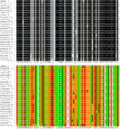 Hemagglutinin alignments
 -
 A profile HMM modelling a multiple sequence alignment


Ad. Transform your health with W8MD Weight Loss, Sleep & MedSpa

Tired of being overweight?
Special offer:
Budget GLP-1 weight loss medications
- Semaglutide starting from $29.99/week and up with insurance for visit of $59.99 and up per week self pay.
- Tirzepatide starting from $45.00/week and up (dose dependent) or $69.99/week and up self pay
✔ Same-week appointments, evenings & weekends
Learn more:
- GLP-1 weight loss clinic NYC
- W8MD's NYC medical weight loss
- W8MD Philadelphia GLP-1 shots
- Philadelphia GLP-1 injections
- Affordable GLP-1 shots NYC
|
WikiMD Medical Encyclopedia |
Medical Disclaimer: WikiMD is for informational purposes only and is not a substitute for professional medical advice. Content may be inaccurate or outdated and should not be used for diagnosis or treatment. Always consult your healthcare provider for medical decisions. Verify information with trusted sources such as CDC.gov and NIH.gov. By using this site, you agree that WikiMD is not liable for any outcomes related to its content. See full disclaimer.
Credits:Most images are courtesy of Wikimedia commons, and templates, categories Wikipedia, licensed under CC BY SA or similar.
Translate this page: - East Asian
中文,
日本,
한국어,
South Asian
हिन्दी,
தமிழ்,
తెలుగు,
Urdu,
ಕನ್ನಡ,
Southeast Asian
Indonesian,
Vietnamese,
Thai,
မြန်မာဘာသာ,
বাংলা
European
español,
Deutsch,
français,
Greek,
português do Brasil,
polski,
română,
русский,
Nederlands,
norsk,
svenska,
suomi,
Italian
Middle Eastern & African
عربى,
Turkish,
Persian,
Hebrew,
Afrikaans,
isiZulu,
Kiswahili,
Other
Bulgarian,
Hungarian,
Czech,
Swedish,
മലയാളം,
मराठी,
ਪੰਜਾਬੀ,
ગુજરાતી,
Portuguese,
Ukrainian
