Blood–testis barrier
Blood–Testis Barrier
The blood–testis barrier (BTB) is a physical barrier between the blood vessels and the seminiferous tubules of the testes. This barrier is formed by tight junctions, adherens junctions and gap junctions between the Sertoli cells, which are located in the seminiferous tubules and are responsible for nurturing developing sperm cells.
Structure[edit]
The Sertoli cells, which form the BTB, are columnar in shape and have a large, oval nucleus. They are connected by tight junctions, adherens junctions and gap junctions, which together form the BTB. The BTB divides the seminiferous tubule into a basal compartment, which is accessible to blood vessels and other cells of the immune system, and an adluminal compartment, which is not accessible to these cells.
Function[edit]
The primary function of the BTB is to protect the developing sperm cells from harmful substances in the blood. It also prevents the immune system from accessing the genetically different sperm cells, thus preventing an immune response. The BTB also creates a unique microenvironment for spermatogenesis, the process of sperm cell development, to occur.
Clinical significance[edit]
Disruption of the BTB can lead to infertility in males. This can occur due to exposure to toxic substances, infection, or trauma. Certain medical conditions, such as varicocele and autoimmune diseases, can also disrupt the BTB and lead to infertility.
See also[edit]
References[edit]

-
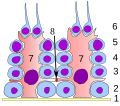 Germinal epithelium testicle

Ad. Transform your health with W8MD Weight Loss, Sleep & MedSpa

Tired of being overweight?
Special offer:
Budget GLP-1 weight loss medications
- Semaglutide starting from $29.99/week and up with insurance for visit of $59.99 and up per week self pay.
- Tirzepatide starting from $45.00/week and up (dose dependent) or $69.99/week and up self pay
✔ Same-week appointments, evenings & weekends
Learn more:
- GLP-1 weight loss clinic NYC
- W8MD's NYC medical weight loss
- W8MD Philadelphia GLP-1 shots
- Philadelphia GLP-1 injections
- Affordable GLP-1 shots NYC
|
WikiMD Medical Encyclopedia |
Medical Disclaimer: WikiMD is for informational purposes only and is not a substitute for professional medical advice. Content may be inaccurate or outdated and should not be used for diagnosis or treatment. Always consult your healthcare provider for medical decisions. Verify information with trusted sources such as CDC.gov and NIH.gov. By using this site, you agree that WikiMD is not liable for any outcomes related to its content. See full disclaimer.
Credits:Most images are courtesy of Wikimedia commons, and templates, categories Wikipedia, licensed under CC BY SA or similar.
Translate this page: - East Asian
中文,
日本,
한국어,
South Asian
हिन्दी,
தமிழ்,
తెలుగు,
Urdu,
ಕನ್ನಡ,
Southeast Asian
Indonesian,
Vietnamese,
Thai,
မြန်မာဘာသာ,
বাংলা
European
español,
Deutsch,
français,
Greek,
português do Brasil,
polski,
română,
русский,
Nederlands,
norsk,
svenska,
suomi,
Italian
Middle Eastern & African
عربى,
Turkish,
Persian,
Hebrew,
Afrikaans,
isiZulu,
Kiswahili,
Other
Bulgarian,
Hungarian,
Czech,
Swedish,
മലയാളം,
मराठी,
ਪੰਜਾਬੀ,
ગુજરાતી,
Portuguese,
Ukrainian
