Explosive
Explosive is a reactive substance that contains a great amount of potential energy that can produce an explosion if released suddenly, usually accompanied by the production of light, heat, sound, and pressure.
An explosion is a rapid increase in volume and release of energy in an extreme manner, usually with the generation of high temperatures and the release of gases. An explosion creates a shock wave.
Types of Explosives[edit]
There are two types of explosives: low explosives and high explosives. Low explosives, or propellants, burn at subsonic speeds. High explosives detonate at supersonic speeds.
Low Explosives[edit]
Low explosives are a type of explosive that deflagrates (burns) rather than detonating. Examples include gunpowder, smokeless powder, and flash powder.
High Explosives[edit]
High explosives, upon initiation, function by detonation, a rapid decomposition (explosion) of the material caused by a shock wave moving through the product at a rate faster than the speed of sound. Examples include dynamite, C-4, and TNT.
Uses of Explosives[edit]
Explosives are used in a variety of applications including mining, demolition, military uses, fireworks, and propulsion.
Safety and Handling[edit]
Handling explosives can be dangerous, especially if the explosive is accidentally detonated. Proper safety measures, including the use of PPE, should be taken when handling explosives.
See Also[edit]
References[edit]
<references />
 | |
|---|---|
 |
 |
Explosive[edit]
-
 Explosive properties of three different types of explosives
 -
 Photo flashes showing Toledo's phenomenal progress
 -
 Blast Area Security
 -
 Handling Explosives in Underground Mines
 -
 GHS pictogram for explosives
 -
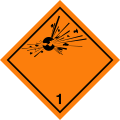 UN transport pictogram for explosives
_(cropped).jpg)


Ad. Transform your health with W8MD Weight Loss, Sleep & MedSpa

Tired of being overweight?
Special offer:
Budget GLP-1 weight loss medications
- Semaglutide starting from $29.99/week and up with insurance for visit of $59.99 and up per week self pay.
- Tirzepatide starting from $45.00/week and up (dose dependent) or $69.99/week and up self pay
✔ Same-week appointments, evenings & weekends
Learn more:
- GLP-1 weight loss clinic NYC
- W8MD's NYC medical weight loss
- W8MD Philadelphia GLP-1 shots
- Philadelphia GLP-1 injections
- Affordable GLP-1 shots NYC
|
WikiMD Medical Encyclopedia |
Medical Disclaimer: WikiMD is for informational purposes only and is not a substitute for professional medical advice. Content may be inaccurate or outdated and should not be used for diagnosis or treatment. Always consult your healthcare provider for medical decisions. Verify information with trusted sources such as CDC.gov and NIH.gov. By using this site, you agree that WikiMD is not liable for any outcomes related to its content. See full disclaimer.
Credits:Most images are courtesy of Wikimedia commons, and templates, categories Wikipedia, licensed under CC BY SA or similar.
Translate this page: - East Asian
中文,
日本,
한국어,
South Asian
हिन्दी,
தமிழ்,
తెలుగు,
Urdu,
ಕನ್ನಡ,
Southeast Asian
Indonesian,
Vietnamese,
Thai,
မြန်မာဘာသာ,
বাংলা
European
español,
Deutsch,
français,
Greek,
português do Brasil,
polski,
română,
русский,
Nederlands,
norsk,
svenska,
suomi,
Italian
Middle Eastern & African
عربى,
Turkish,
Persian,
Hebrew,
Afrikaans,
isiZulu,
Kiswahili,
Other
Bulgarian,
Hungarian,
Czech,
Swedish,
മലയാളം,
मराठी,
ਪੰਜਾਬੀ,
ગુજરાતી,
Portuguese,
Ukrainian
