G-arm medical imaging
G-arm is an advanced medical imaging technology used in various surgical and diagnostic procedures. It represents a significant evolution in the field of X-ray imaging, providing a more versatile and comprehensive view of the patient's anatomy during surgery. The G-arm system integrates two different imaging sources into a single machine, allowing for simultaneous bi-planar image acquisition. This means that it can provide both frontal and lateral images at the same time, which is particularly beneficial in complex orthopedic, spinal, and neurosurgical procedures.
Overview[edit]
The G-arm system is designed to enhance the efficiency and accuracy of surgical interventions. Its dual imaging capability allows surgeons to view the operative area in two planes without the need to reposition the patient or the equipment. This not only saves time but also reduces the exposure to radiation for both the patient and the surgical team. The G-arm's sophisticated software also enables real-time image processing, including features such as image rotation, zoom, and contrast adjustment, further aiding in the precision of surgical procedures.
Applications[edit]
G-arm technology finds its applications in a wide range of surgical procedures. It is particularly useful in:
- Orthopedic surgery: For precise placement of implants and fracture fixation.
- Spinal surgery: Offers critical insights for alignment and hardware positioning.
- Neurosurgery: Assists in procedures requiring pinpoint accuracy.
- Vascular surgery: Provides live imaging to guide the procedure.
- Pain management: Helps in accurately targeting the source of pain for injections or treatments.
Advantages[edit]
The G-arm system offers several advantages over traditional single-plane C-arm systems, including:
- Reduced surgery time due to simultaneous bi-planar imaging.
- Decreased radiation exposure.
- Improved surgical accuracy and outcomes.
- Enhanced visualization of complex anatomies.
- Real-time imaging capabilities that support a wide range of procedures.
Challenges[edit]
Despite its benefits, the G-arm system also presents certain challenges. These include:
- Higher cost compared to traditional imaging systems.
- Requires specialized training for optimal operation.
- Larger footprint in the operating room, necessitating adequate space.
Future Directions[edit]
The future of G-arm technology is promising, with ongoing advancements aimed at further reducing radiation exposure, enhancing image quality, and integrating with other surgical technologies such as robotic surgery systems. As these improvements continue, the G-arm is expected to become an even more indispensable tool in modern surgery.

-
 G-arm main components
 -
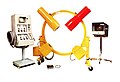 Multiplanar 1970


Ad. Transform your health with W8MD Weight Loss, Sleep & MedSpa

Tired of being overweight?
Special offer:
Budget GLP-1 weight loss medications
- Semaglutide starting from $29.99/week and up with insurance for visit of $59.99 and up per week self pay.
- Tirzepatide starting from $45.00/week and up (dose dependent) or $69.99/week and up self pay
✔ Same-week appointments, evenings & weekends
Learn more:
- GLP-1 weight loss clinic NYC
- W8MD's NYC medical weight loss
- W8MD Philadelphia GLP-1 shots
- Philadelphia GLP-1 injections
- Affordable GLP-1 shots NYC
|
WikiMD Medical Encyclopedia |
Medical Disclaimer: WikiMD is for informational purposes only and is not a substitute for professional medical advice. Content may be inaccurate or outdated and should not be used for diagnosis or treatment. Always consult your healthcare provider for medical decisions. Verify information with trusted sources such as CDC.gov and NIH.gov. By using this site, you agree that WikiMD is not liable for any outcomes related to its content. See full disclaimer.
Credits:Most images are courtesy of Wikimedia commons, and templates, categories Wikipedia, licensed under CC BY SA or similar.
Translate this page: - East Asian
中文,
日本,
한국어,
South Asian
हिन्दी,
தமிழ்,
తెలుగు,
Urdu,
ಕನ್ನಡ,
Southeast Asian
Indonesian,
Vietnamese,
Thai,
မြန်မာဘာသာ,
বাংলা
European
español,
Deutsch,
français,
Greek,
português do Brasil,
polski,
română,
русский,
Nederlands,
norsk,
svenska,
suomi,
Italian
Middle Eastern & African
عربى,
Turkish,
Persian,
Hebrew,
Afrikaans,
isiZulu,
Kiswahili,
Other
Bulgarian,
Hungarian,
Czech,
Swedish,
മലയാളം,
मराठी,
ਪੰਜਾਬੀ,
ગુજરાતી,
Portuguese,
Ukrainian
