Sagittaria latifolia

Sagittaria latifolia, commonly known as broadleaf arrowhead, duck potato, Indian potato, or wapato, is a perennial aquatic plant native to North America, notable for its edible tubers which have been consumed by Indigenous peoples and wildlife alike for thousands of years. This species belongs to the Alismataceae family, which is characterized by plants that are mostly aquatic and prefer wet, swampy conditions.
Description[edit]
Sagittaria latifolia is easily identifiable by its distinctive arrowhead-shaped leaves, which give the plant its common name. It grows in shallow waters and wetlands, producing tall flower stalks that rise above the water level. The flowers are white and consist of three petals, blooming from July to September. The plant's fruit is a small, spherical cluster of achenes, while its most notable feature, the tuber, grows underwater attached to long, slender rhizomes.
Habitat and Distribution[edit]
Sagittaria latifolia is found across a wide range of freshwater wetland habitats in North America, from slow-moving rivers and lakes to marshes and ponds. Its distribution spans from the northern regions of Canada down to the southern United States, showcasing its adaptability to various climates and water conditions.
Cultural and Historical Significance[edit]
The tubers of Sagittaria latifolia have been a significant food source for Indigenous peoples across North America. These tubers, often referred to as "duck potatoes," were traditionally harvested by wading into water and loosening the tubers from the mud with the feet. They were then collected, cooked, and eaten or stored for winter use. This practice not only highlights the plant's nutritional value but also its integral role in traditional diets and cultures.
Ecological Role[edit]
Sagittaria latifolia plays a crucial role in its ecosystem, providing habitat and food for various wildlife species. Its dense growth can offer shelter for small fish and amphibians, while the seeds and tubers are a food source for ducks and other waterfowl, contributing to the biodiversity of wetland areas.
Cultivation and Uses[edit]
Apart from its historical consumption by Indigenous peoples, Sagittaria latifolia is also cultivated for ornamental purposes in water gardens and ponds. Its attractive flowers and unique leaf shape make it a popular choice for aquatic landscaping. Additionally, there is growing interest in the plant as a sustainable food source, given its nutritious tubers and adaptability to different environments.
Conservation[edit]
While Sagittaria latifolia is not currently listed as endangered, its habitat is increasingly threatened by wetland degradation and pollution. Conservation efforts are essential to preserve these ecosystems, ensuring the survival of this species and the countless others that depend on wetland habitats.

-
 Sagittaria latifolia (flowers)
 -
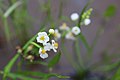 Sagittaria latifolia
.jpg)

Ad. Transform your health with W8MD Weight Loss, Sleep & MedSpa

Tired of being overweight?
Special offer:
Budget GLP-1 weight loss medications
- Semaglutide starting from $29.99/week and up with insurance for visit of $59.99 and up per week self pay.
- Tirzepatide starting from $45.00/week and up (dose dependent) or $69.99/week and up self pay
✔ Same-week appointments, evenings & weekends
Learn more:
- GLP-1 weight loss clinic NYC
- W8MD's NYC medical weight loss
- W8MD Philadelphia GLP-1 shots
- Philadelphia GLP-1 injections
- Affordable GLP-1 shots NYC
|
WikiMD Medical Encyclopedia |
Medical Disclaimer: WikiMD is for informational purposes only and is not a substitute for professional medical advice. Content may be inaccurate or outdated and should not be used for diagnosis or treatment. Always consult your healthcare provider for medical decisions. Verify information with trusted sources such as CDC.gov and NIH.gov. By using this site, you agree that WikiMD is not liable for any outcomes related to its content. See full disclaimer.
Credits:Most images are courtesy of Wikimedia commons, and templates, categories Wikipedia, licensed under CC BY SA or similar.
Translate this page: - East Asian
中文,
日本,
한국어,
South Asian
हिन्दी,
தமிழ்,
తెలుగు,
Urdu,
ಕನ್ನಡ,
Southeast Asian
Indonesian,
Vietnamese,
Thai,
မြန်မာဘာသာ,
বাংলা
European
español,
Deutsch,
français,
Greek,
português do Brasil,
polski,
română,
русский,
Nederlands,
norsk,
svenska,
suomi,
Italian
Middle Eastern & African
عربى,
Turkish,
Persian,
Hebrew,
Afrikaans,
isiZulu,
Kiswahili,
Other
Bulgarian,
Hungarian,
Czech,
Swedish,
മലയാളം,
मराठी,
ਪੰਜਾਬੀ,
ગુજરાતી,
Portuguese,
Ukrainian
