Monoculture
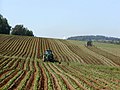
Monoculture is a farming or agricultural practice where a single species or variety of a plant is grown over a large area for a number of consecutive years. The practice is common in modern industrial agriculture, which prioritizes maximizing the yield of a single crop.
History[edit]
The practice of monoculture has been prevalent since the advent of agriculture. Early farmers cultivated a single crop in a given area, primarily due to the ease of planting, harvesting, and managing a single type of plant. However, the scale and intensity of monoculture farming have significantly increased with the advent of modern agricultural techniques.
Advantages[edit]
Monoculture farming has several advantages. It allows for a streamlined farming process, as the same operations can be applied across the entire field. This can lead to increased efficiency and potentially higher yields. Monoculture also allows for easier mechanization, as the same machinery can be used across the entire field.
Disadvantages[edit]
Despite its advantages, monoculture farming also has several disadvantages. It can lead to a loss of biodiversity, as other plant species are not able to thrive in a monoculture environment. This can have negative impacts on the local ecosystem. Monoculture farming can also lead to increased vulnerability to pests and diseases, as a single pest or disease can potentially wipe out an entire crop. In addition, monoculture can lead to soil degradation, as the continuous cultivation of a single crop can deplete the soil of certain nutrients.
Alternatives[edit]
Alternatives to monoculture farming include polyculture, where multiple crops are grown in the same space, and crop rotation, where different crops are planted in a sequence to improve soil health and reduce pest and disease pressure.
See also[edit]

This article is a agriculture stub. You can help WikiMD by expanding it!
-
 Monoculture
 -
 Monoculture

_(62)_(50224604772).jpg)
Ad. Transform your health with W8MD Weight Loss, Sleep & MedSpa

Tired of being overweight?
Special offer:
Budget GLP-1 weight loss medications
- Semaglutide starting from $29.99/week and up with insurance for visit of $59.99 and up per week self pay.
- Tirzepatide starting from $45.00/week and up (dose dependent) or $69.99/week and up self pay
✔ Same-week appointments, evenings & weekends
Learn more:
- GLP-1 weight loss clinic NYC
- W8MD's NYC medical weight loss
- W8MD Philadelphia GLP-1 shots
- Philadelphia GLP-1 injections
- Affordable GLP-1 shots NYC
|
WikiMD Medical Encyclopedia |
Medical Disclaimer: WikiMD is for informational purposes only and is not a substitute for professional medical advice. Content may be inaccurate or outdated and should not be used for diagnosis or treatment. Always consult your healthcare provider for medical decisions. Verify information with trusted sources such as CDC.gov and NIH.gov. By using this site, you agree that WikiMD is not liable for any outcomes related to its content. See full disclaimer.
Credits:Most images are courtesy of Wikimedia commons, and templates, categories Wikipedia, licensed under CC BY SA or similar.
Translate this page: - East Asian
中文,
日本,
한국어,
South Asian
हिन्दी,
தமிழ்,
తెలుగు,
Urdu,
ಕನ್ನಡ,
Southeast Asian
Indonesian,
Vietnamese,
Thai,
မြန်မာဘာသာ,
বাংলা
European
español,
Deutsch,
français,
Greek,
português do Brasil,
polski,
română,
русский,
Nederlands,
norsk,
svenska,
suomi,
Italian
Middle Eastern & African
عربى,
Turkish,
Persian,
Hebrew,
Afrikaans,
isiZulu,
Kiswahili,
Other
Bulgarian,
Hungarian,
Czech,
Swedish,
മലയാളം,
मराठी,
ਪੰਜਾਬੀ,
ગુજરાતી,
Portuguese,
Ukrainian
