Tarantula

A tarantula in its natural habitat | |
| Scientific classification | |
| Kingdom | |
| Phylum | Arthropoda |
| Class | |
| Order | |
| Family | |
| Genus | ' |
| Species | ' |
| Binomial name | |
| Binomial authority | |
| Synonyms | |
The tarantula is a group of large and often hairy spiders belonging to the family Theraphosidae. Tarantulas are found in a wide range of environments around the world, particularly in tropical, subtropical, and desert regions. Despite their fearsome appearance and reputation, tarantulas are generally harmless to humans, with bites that are usually no worse than a bee sting in terms of toxicity.
Description[edit]
Tarantulas vary greatly in size, color, and behavior, depending on the species. They can range in size from as small as a fingernail to as large as a dinner plate when including their leg span. The body of a tarantula is divided into two main parts: the cephalothorax and the abdomen. They have eight legs, two pedipalps for manipulating food, and chelicerae equipped with fangs that inject venom into their prey.
Habitat and Distribution[edit]
Tarantulas inhabit a variety of environments. Some species prefer underground burrows, while others are arboreal, living in trees. Their distribution spans across the Americas, Africa, Asia, and Australia. Each species has adapted to its specific environment, from rainforests to deserts.
Diet[edit]
Tarantulas are primarily nocturnal hunters, preying on insects and other small animals. Larger species can even prey on small birds, lizards, and rodents. They rely on ambush and pursuit to catch their prey, using their venom to subdue it.
Reproduction[edit]
Tarantula reproduction involves a male depositing sperm into a female's reproductive tract. The female then lays eggs in a silk cocoon and guards them until they hatch. The number of offspring can vary greatly, with some species producing hundreds of spiderlings.
Conservation[edit]
While many tarantula species are common and have stable populations, others are threatened by habitat destruction, the pet trade, and climate change. Conservation efforts are in place for some of the more vulnerable species to ensure their survival.
In Culture[edit]
Tarantulas have a significant presence in popular culture, often depicted in movies, literature, and as exotic pets. Despite their portrayal as dangerous creatures, they are generally shy and reclusive, posing little threat to humans.

-
 Tarantula
 -
 Tarantula
 -
 Tarantula
 -
 Tarantula
 -
 Tarantula
 -
 Tarantula
 -
 Tarantula
 -
 Tarantula
 -
 Tarantula
 -
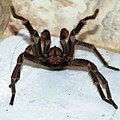 Tarantula
 -
 Tarantula
 -
 Tarantula


Ad. Transform your health with W8MD Weight Loss, Sleep & MedSpa

Tired of being overweight?
Special offer:
Budget GLP-1 weight loss medications
- Semaglutide starting from $29.99/week and up with insurance for visit of $59.99 and up per week self pay.
- Tirzepatide starting from $45.00/week and up (dose dependent) or $69.99/week and up self pay
✔ Same-week appointments, evenings & weekends
Learn more:
- GLP-1 weight loss clinic NYC
- W8MD's NYC medical weight loss
- W8MD Philadelphia GLP-1 shots
- Philadelphia GLP-1 injections
- Affordable GLP-1 shots NYC
|
WikiMD Medical Encyclopedia |
Medical Disclaimer: WikiMD is for informational purposes only and is not a substitute for professional medical advice. Content may be inaccurate or outdated and should not be used for diagnosis or treatment. Always consult your healthcare provider for medical decisions. Verify information with trusted sources such as CDC.gov and NIH.gov. By using this site, you agree that WikiMD is not liable for any outcomes related to its content. See full disclaimer.
Credits:Most images are courtesy of Wikimedia commons, and templates, categories Wikipedia, licensed under CC BY SA or similar.
Translate this page: - East Asian
中文,
日本,
한국어,
South Asian
हिन्दी,
தமிழ்,
తెలుగు,
Urdu,
ಕನ್ನಡ,
Southeast Asian
Indonesian,
Vietnamese,
Thai,
မြန်မာဘာသာ,
বাংলা
European
español,
Deutsch,
français,
Greek,
português do Brasil,
polski,
română,
русский,
Nederlands,
norsk,
svenska,
suomi,
Italian
Middle Eastern & African
عربى,
Turkish,
Persian,
Hebrew,
Afrikaans,
isiZulu,
Kiswahili,
Other
Bulgarian,
Hungarian,
Czech,
Swedish,
മലയാളം,
मराठी,
ਪੰਜਾਬੀ,
ગુજરાતી,
Portuguese,
Ukrainian
