Jahn–Teller effect
Jahn–Teller Effect
The Jahn–Teller effect (often abbreviated as JT effect) is a distortion of a non-linear molecular system that reduces its symmetry and energy. It is a phenomenon observed in certain molecular geometries where a degenerate electronic state leads to structural deformations, thereby lifting the degeneracy and stabilizing the molecule. This effect was first predicted by Hermann Arthur Jahn and Edward Teller in 1937, and it plays a crucial role in the fields of chemistry, solid state physics, and material science.
Overview[edit]
The Jahn–Teller effect is particularly relevant for molecules and ions that have an electronic ground state that is orbitally degenerate. According to the Jahn–Teller theorem, any non-linear molecule with a degenerate electronic ground state will undergo a distortion to remove that degeneracy, because the distortion lowers the overall energy of the system. This effect is most commonly observed in octahedral complexes with d9, d7, or high-spin d4 electronic configurations, but it can also occur in other geometries and electronic configurations.
Types of Jahn–Teller Distortions[edit]
Jahn–Teller distortions can be classified into two main types: static and dynamic.
- Static Jahn–Teller effect occurs when the distortion is permanent and can be observed in the structure of the molecule or ion at rest.
- Dynamic Jahn–Teller effect involves a rapid fluctuation between multiple distorted configurations, making it difficult to observe directly in the molecular structure.
Consequences[edit]
The Jahn–Teller effect has several important consequences for the properties of materials and molecules. It can influence the color, magnetic properties, and electrical conductivity of materials. In coordination chemistry, it affects the geometries and stability of complexes. Understanding the Jahn–Teller effect is also crucial for designing materials with specific electronic, magnetic, and optical properties.
Examples[edit]
A classic example of the Jahn–Teller effect is observed in the copper(II) ion (Cu2+) in an octahedral environment, which due to its d9 configuration, undergoes a distortion to lower its symmetry and stabilize the ion. Another example can be found in the high-temperature superconductors based on copper oxides, where the Jahn–Teller effect plays a significant role in their superconducting properties.
See Also[edit]
References[edit]
<references/>


-
 Hexaaquacopper(II) complex
 -
 Jahn-Teller effect in octahedral complexes
 -
 COT radical anion Frost orbs
 -
 Jahn-Teller and pseudo Jahn-Teller effects
 -
 E x e potential energy surfaces
 -
 Jahn-Teller distortions of a triangle
 -
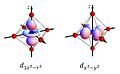 D orbitals in an octahedron
 -
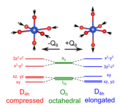 D levels
-3D-balls.png)


Ad. Transform your life with W8MD's
GLP-1 weight loss injections special from $29.99 with insurance
|
WikiMD Medical Encyclopedia |
Medical Disclaimer: WikiMD is for informational purposes only and is not a substitute for professional medical advice. Content may be inaccurate or outdated and should not be used for diagnosis or treatment. Always consult your healthcare provider for medical decisions. Verify information with trusted sources such as CDC.gov and NIH.gov. By using this site, you agree that WikiMD is not liable for any outcomes related to its content. See full disclaimer.
Credits:Most images are courtesy of Wikimedia commons, and templates, categories Wikipedia, licensed under CC BY SA or similar.
Translate this page: - East Asian
中文,
日本,
한국어,
South Asian
हिन्दी,
தமிழ்,
తెలుగు,
Urdu,
ಕನ್ನಡ,
Southeast Asian
Indonesian,
Vietnamese,
Thai,
မြန်မာဘာသာ,
বাংলা
European
español,
Deutsch,
français,
Greek,
português do Brasil,
polski,
română,
русский,
Nederlands,
norsk,
svenska,
suomi,
Italian
Middle Eastern & African
عربى,
Turkish,
Persian,
Hebrew,
Afrikaans,
isiZulu,
Kiswahili,
Other
Bulgarian,
Hungarian,
Czech,
Swedish,
മലയാളം,
मराठी,
ਪੰਜਾਬੀ,
ગુજરાતી,
Portuguese,
Ukrainian
