Olive baboon
Olive Baboon (Papio anubis), also known as the Anubis baboon, is a species of baboon from the Old World monkey family. It is one of the largest and most widespread of all baboons, being found in 25 countries throughout Africa, extending from Mali eastward to Ethiopia and Tanzania. Characterized by its greenish-brown or olive color, it lives in various habitats, from savannahs to forests. This article provides an overview of the Olive Baboon, including its taxonomy, physical description, behavior, diet, reproduction, and conservation status.
Taxonomy and Evolution[edit]
The Olive Baboon is a member of the genus Papio, which includes all baboons. It is classified under the family Cercopithecidae (Old World monkeys). The scientific name of the Olive Baboon is Papio anubis. The species was first described by Johann Friedrich Blumenbach in 1777. Baboons are part of the order Primates, which also includes humans, apes, and other monkeys.
Description[edit]
Olive Baboons are large, with males significantly larger than females. Males can weigh between 24 to 45 kg (53 to 99 lb), while females weigh between 14 to 25 kg (31 to 55 lb). They have a dog-like face, long, powerful jaws, and sharp canine teeth. Their body is covered with olive-green fur, which gives them their name. They have a tail that is longer than their body, which ends in a small tuft.
Behavior[edit]
Olive Baboons live in large, mixed-sex groups known as troops, which can contain up to 150 individuals. These troops are organized into a strict hierarchy, with a dominant male leading the group. They are diurnal, spending most of the day foraging for food, and they sleep in trees at night to avoid predators.
Social Structure[edit]
The social structure of Olive Baboons is complex, with strong bonds forming between females and their offspring, while males may form alliances to improve their social standing. Grooming plays a crucial role in social interactions, helping to establish and maintain relationships within the troop.
Diet[edit]
Olive Baboons are omnivorous, with a diet that includes a wide variety of plants and animals. They eat fruits, leaves, seeds, and roots, as well as insects, fish, and small mammals. Their ability to adapt their diet to available resources has allowed them to thrive in various environments.
Reproduction[edit]
Females reach sexual maturity at about 4 years of age, while males mature at around 5 to 8 years. There is no specific breeding season for Olive Baboons; females can give birth at any time of the year after a gestation period of approximately 6 months. Typically, a female gives birth to a single offspring.
Conservation Status[edit]
The Olive Baboon is classified as Least Concern by the International Union for Conservation of Nature (IUCN). Although it is widespread and adaptable, it faces threats from habitat destruction and hunting in some areas. Conservation efforts are focused on habitat preservation and mitigating human-wildlife conflict.
See Also[edit]
.png)
-
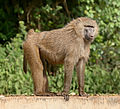 Olive baboon
 -
 Olive baboon
 -
 Olive baboon
 -
 Olive baboon
 -
 Olive baboon
 -
 Olive baboon
 -
 Olive baboon
 -
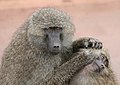 Olive baboon
 -
 Olive baboon
 -
 Olive baboon
 -
 Olive baboon


_suckling,_Semliki_Wildlife_Reserve.jpg)
_with_juvenile.jpg)


Ad. Transform your health with W8MD Weight Loss, Sleep & MedSpa

Tired of being overweight?
Special offer:
Budget GLP-1 weight loss medications
- Semaglutide starting from $29.99/week and up with insurance for visit of $59.99 and up per week self pay.
- Tirzepatide starting from $45.00/week and up (dose dependent) or $69.99/week and up self pay
✔ Same-week appointments, evenings & weekends
Learn more:
- GLP-1 weight loss clinic NYC
- W8MD's NYC medical weight loss
- W8MD Philadelphia GLP-1 shots
- Philadelphia GLP-1 injections
- Affordable GLP-1 shots NYC
|
WikiMD Medical Encyclopedia |
Medical Disclaimer: WikiMD is for informational purposes only and is not a substitute for professional medical advice. Content may be inaccurate or outdated and should not be used for diagnosis or treatment. Always consult your healthcare provider for medical decisions. Verify information with trusted sources such as CDC.gov and NIH.gov. By using this site, you agree that WikiMD is not liable for any outcomes related to its content. See full disclaimer.
Credits:Most images are courtesy of Wikimedia commons, and templates, categories Wikipedia, licensed under CC BY SA or similar.
Translate this page: - East Asian
中文,
日本,
한국어,
South Asian
हिन्दी,
தமிழ்,
తెలుగు,
Urdu,
ಕನ್ನಡ,
Southeast Asian
Indonesian,
Vietnamese,
Thai,
မြန်မာဘာသာ,
বাংলা
European
español,
Deutsch,
français,
Greek,
português do Brasil,
polski,
română,
русский,
Nederlands,
norsk,
svenska,
suomi,
Italian
Middle Eastern & African
عربى,
Turkish,
Persian,
Hebrew,
Afrikaans,
isiZulu,
Kiswahili,
Other
Bulgarian,
Hungarian,
Czech,
Swedish,
മലയാളം,
मराठी,
ਪੰਜਾਬੀ,
ગુજરાતી,
Portuguese,
Ukrainian
