Necklace
Necklace
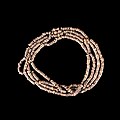
A Necklace is a form of jewelry that is typically worn around the neck. Necklaces have been an integral part of jewelry since the time of ancient civilizations and are often used as symbols of wealth, status, or religious beliefs.
History[edit]
The history of the necklace spans thousands of years. The oldest known necklaces were made of purely natural materials, such as bones, feathers, shells, and plant materials. The Ancient Egyptians were known for their elaborate necklace designs, often made from gold and precious gemstones. The Ancient Greeks and Romans also wore necklaces, often adorned with amulets and talismans.
Types of Necklaces[edit]
There are many different types of necklaces, each with its own unique style and purpose. Some of the most common types include:
- Choker: A choker is a close-fitting necklace worn around the neck. Chokers can be made of a variety of materials, including velvet, plastic, beads, metal, and leather.
- Pendant: A pendant necklace is a necklace that has a hanging element of any type. The pendant can be made of any material and can be of any size.
- Locket: A locket is a pendant that opens to reveal a space used for storing a photograph or other small item.
- Chain: A chain necklace is a type of necklace that is made up of links. Chains can be made of various metals and can come in various lengths and thicknesses.
Materials[edit]
Necklaces can be made from a variety of materials. Some of the most common materials used in necklace construction include:
- Gold: Gold is a popular material for necklaces due to its luster and durability.
- Silver: Silver is another popular material for necklaces. It is often used for its shiny appearance and affordability.
- Gemstones: Gemstones, such as diamonds, rubies, and emeralds, are often used in necklaces for their beauty and value.
- Pearls: Pearls are often used in necklaces for their elegance and timeless appeal.
Cultural Significance[edit]
Necklaces often hold cultural significance. In many cultures, necklaces are used as symbols of wealth, status, or religious beliefs. For example, in Hinduism, the Rudraksha necklace is considered sacred and is worn as a symbol of devotion.
See Also[edit]
This jewelry-related article is a stub. You can help WikiMD by expanding it.
-
 Necklace
 -
 Necklace
 -
 Necklace
 -
 Necklace
 -
 Necklace
 -
 Necklace
 -
 Necklace
 -
 Necklace
 -
 Necklace
 -
 Necklace
 -
 Necklace
 -
 Necklace


Ad. Transform your health with W8MD Weight Loss, Sleep & MedSpa

Tired of being overweight?
Special offer:
Budget GLP-1 weight loss medications
- Semaglutide starting from $29.99/week and up with insurance for visit of $59.99 and up per week self pay.
- Tirzepatide starting from $45.00/week and up (dose dependent) or $69.99/week and up self pay
✔ Same-week appointments, evenings & weekends ✔ Tele visits available with certain limitations Learn more:
- GLP-1 weight loss clinic NYC
- W8MD's NYC medical weight loss
- W8MD Philadelphia GLP-1 shots
- Philadelphia GLP-1 injections
- Affordable GLP-1 shots NYC
- Budget GLP-1 shots
|
WikiMD Medical Encyclopedia |
Medical Disclaimer: WikiMD is for informational purposes only and is not a substitute for professional medical advice. Content may be inaccurate or outdated and should not be used for diagnosis or treatment. Always consult your healthcare provider for medical decisions. Verify information with trusted sources such as CDC.gov and NIH.gov. By using this site, you agree that WikiMD is not liable for any outcomes related to its content. See full disclaimer.
Credits:Most images are courtesy of Wikimedia commons, and templates, categories Wikipedia, licensed under CC BY SA or similar.
Translate this page: - East Asian
中文,
日本,
한국어,
South Asian
हिन्दी,
தமிழ்,
తెలుగు,
Urdu,
ಕನ್ನಡ,
Southeast Asian
Indonesian,
Vietnamese,
Thai,
မြန်မာဘာသာ,
বাংলা
European
español,
Deutsch,
français,
Greek,
português do Brasil,
polski,
română,
русский,
Nederlands,
norsk,
svenska,
suomi,
Italian
Middle Eastern & African
عربى,
Turkish,
Persian,
Hebrew,
Afrikaans,
isiZulu,
Kiswahili,
Other
Bulgarian,
Hungarian,
Czech,
Swedish,
മലയാളം,
मराठी,
ਪੰਜਾਬੀ,
ગુજરાતી,
Portuguese,
Ukrainian
