Homology (biology)
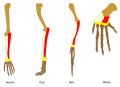
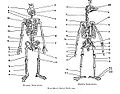
Homology (biology) refers to the existence of shared ancestry between a pair of structures, or genes, in different taxa. A classic example of homology is the similarity in the limb structures of vertebrates, such as humans, birds, and whales, which have evolved for different purposes but originate from a common ancestor. The concept of homology is fundamental in the field of evolutionary biology and helps scientists understand the evolutionary relationships among organisms.
Definition and Types[edit]
Homology is defined by the presence of an ancestral trait shared by two or more species. This concept can be divided into several types, including:
- Morphological homology: Refers to similarities in the structure of body parts or organs due to shared ancestry. For example, the forelimbs of mammals are morphologically homologous.
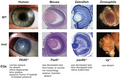
- Molecular homology: Involves similarities in the molecular sequences of DNA, RNA, or proteins among different species, indicating a common genetic heritage. For example, the genetic code is nearly universal, reflecting its homologous nature across life forms.
- Developmental homology: Refers to similarities in the developmental processes of different organisms, suggesting a common evolutionary origin. An example is the pharyngeal arches in the embryos of fish and humans.
Evolutionary Significance[edit]
Homology is a critical concept in evolutionary biology, providing evidence for the theory of evolution by natural selection. It supports the idea that all life on Earth shares a common ancestry and that complex structures can evolve from simpler ones through gradual modifications over time. Homologies, especially those identified at the molecular level, are used to construct phylogenetic trees, which depict the evolutionary relationships among species.
Homology vs. Analogy[edit]
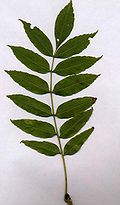
It is important to distinguish between homology and analogy. While homology refers to similarities due to shared ancestry, analogy refers to similarities in function or appearance that arise independently in different lineages, often due to convergent evolution. For example, the wings of birds and insects are analogous structures, as they serve similar functions but do not originate from a common ancestral wing.
Identification and Analysis[edit]
Identifying homologous structures or sequences involves comparative anatomy, embryology, and molecular biology. Scientists compare the form, structure, and genetic makeup of different organisms to identify homologies and infer evolutionary relationships. Advanced techniques, such as DNA sequencing and bioinformatics, play a crucial role in the analysis of molecular homologies.
Challenges and Controversies[edit]
The identification of homologies can sometimes be challenging, especially when dealing with deep evolutionary divergences or rapid radiations. Additionally, the distinction between homology and analogy can be blurred in cases of extreme convergent evolution. Despite these challenges, the concept of homology remains a cornerstone of evolutionary biology.

-
 Homology (biology)
 -
 Homology (biology)
 -
 Homology (biology)
 -
 Homology (biology)
 -
 Homology (biology)
 -
 Homology (biology)
 -
 Homology (biology)
 -
 Homology (biology)
 -
 Homology (biology)
 -
 Homology (biology)
 -
 Homology (biology)
 -
 Homology (biology)


.png)


.jpg)
Ad. Transform your health with W8MD Weight Loss, Sleep & MedSpa

Tired of being overweight?
Special offer:
Budget GLP-1 weight loss medications
- Semaglutide starting from $29.99/week and up with insurance for visit of $59.99 and up per week self pay.
- Tirzepatide starting from $45.00/week and up (dose dependent) or $69.99/week and up self pay
✔ Same-week appointments, evenings & weekends
Learn more:
- GLP-1 weight loss clinic NYC
- W8MD's NYC medical weight loss
- W8MD Philadelphia GLP-1 shots
- Philadelphia GLP-1 injections
- Affordable GLP-1 shots NYC
|
WikiMD Medical Encyclopedia |
Medical Disclaimer: WikiMD is for informational purposes only and is not a substitute for professional medical advice. Content may be inaccurate or outdated and should not be used for diagnosis or treatment. Always consult your healthcare provider for medical decisions. Verify information with trusted sources such as CDC.gov and NIH.gov. By using this site, you agree that WikiMD is not liable for any outcomes related to its content. See full disclaimer.
Credits:Most images are courtesy of Wikimedia commons, and templates, categories Wikipedia, licensed under CC BY SA or similar.
Translate this page: - East Asian
中文,
日本,
한국어,
South Asian
हिन्दी,
தமிழ்,
తెలుగు,
Urdu,
ಕನ್ನಡ,
Southeast Asian
Indonesian,
Vietnamese,
Thai,
မြန်မာဘာသာ,
বাংলা
European
español,
Deutsch,
français,
Greek,
português do Brasil,
polski,
română,
русский,
Nederlands,
norsk,
svenska,
suomi,
Italian
Middle Eastern & African
عربى,
Turkish,
Persian,
Hebrew,
Afrikaans,
isiZulu,
Kiswahili,
Other
Bulgarian,
Hungarian,
Czech,
Swedish,
മലയാളം,
मराठी,
ਪੰਜਾਬੀ,
ગુજરાતી,
Portuguese,
Ukrainian
