Minangkabau people
Minangkabau people are an ethnic group indigenous to the Minangkabau Highlands of West Sumatra, Indonesia. They are the largest matrilineal society in the world, with property, family name and land passing down from mother to daughter. The Minangkabau are strongly Islamic, but also follow their ethnic traditions, or adat.
Etymology[edit]
The name Minangkabau is thought to be a conjunction of two words, minang ("victorious") and kabau ("buffalo"). According to legend, this name was adopted when the Minangkabau people successfully defeated invaders from the Majapahit Empire.
Culture[edit]
Minangkabau culture is matrilineal and patriarchal, with property and land passing down from mother to daughter, while religious and political affairs are the responsibility of men. This is known as Adat perpatih, a tradition that originated from the animistic and Hindu-Buddhist times of their history, before the arrival of Islam.
Cuisine[edit]
Minangkabau cuisine, also known as Padang cuisine, is popular throughout Indonesia. The most famous dish, Rendang, is a spicy meat dish.
Migration[edit]
The Minangkabau strongly value education, and this has resulted in a large diaspora of Minangkabau people, who have been successful in a variety of professions, both in Indonesia and in other countries.
See also[edit]
 Ethnic groups in Indonesia by region
 |
||||||||||
|---|---|---|---|---|---|---|---|---|---|---|
|

-
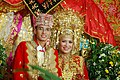 Minangkabau people
 -
 Adityawarman
 -
 Flag of Minang
 -
 Tuanku Imam Bonjol
 -
 Minangkabau people
 -
 Pariangan
 -
 Minangkabau house with rice barns
 -
 Traditional Minang costumes
 -
 Minangkabau men
 -
 Minangkabau dancers
 -
 Minangkabau procession
 -
 Tabuik festival


Ad. Transform your life with W8MD's
GLP-1 weight loss injections special from $29.99 with insurance
|
WikiMD Medical Encyclopedia |
Medical Disclaimer: WikiMD is for informational purposes only and is not a substitute for professional medical advice. Content may be inaccurate or outdated and should not be used for diagnosis or treatment. Always consult your healthcare provider for medical decisions. Verify information with trusted sources such as CDC.gov and NIH.gov. By using this site, you agree that WikiMD is not liable for any outcomes related to its content. See full disclaimer.
Credits:Most images are courtesy of Wikimedia commons, and templates, categories Wikipedia, licensed under CC BY SA or similar.
Translate this page: - East Asian
中文,
日本,
한국어,
South Asian
हिन्दी,
தமிழ்,
తెలుగు,
Urdu,
ಕನ್ನಡ,
Southeast Asian
Indonesian,
Vietnamese,
Thai,
မြန်မာဘာသာ,
বাংলা
European
español,
Deutsch,
français,
Greek,
português do Brasil,
polski,
română,
русский,
Nederlands,
norsk,
svenska,
suomi,
Italian
Middle Eastern & African
عربى,
Turkish,
Persian,
Hebrew,
Afrikaans,
isiZulu,
Kiswahili,
Other
Bulgarian,
Hungarian,
Czech,
Swedish,
മലയാളം,
मराठी,
ਪੰਜਾਬੀ,
ગુજરાતી,
Portuguese,
Ukrainian
