Population pyramid
Population pyramid is a graphical representation that shows the distribution of various age groups in a population, which forms the shape of a pyramid when the population is growing. It is also used to describe the age and sex structure of the population.
Overview[edit]
A population pyramid, also known as an "age-sex pyramid", is a graphical illustration that shows the distribution of various age groups in a population (typically that of a country or region of the world), which forms the shape of a pyramid when the population is growing. It is also used to describe the age and sex structure of the population.
Structure[edit]
The population pyramid typically consists of two back-to-back bar graphs, with the population plotted on the X-axis and age on the Y-axis, one showing the number of males and one showing females in a particular population in five-year age groups (also called cohorts). Males are conventionally shown on the left and females on the right, and they may be measured by raw number or as a percentage of the total population.
Types of Population Pyramids[edit]
There are three types of population pyramids that demonstrate the three types of population growth. These are expansive, constrictive, and stationary population pyramids.
Expansive[edit]
An expansive population pyramid represents a population that has a larger percentage of people in younger age groups. This type of population pyramid indicates high birth and death rates.
Constrictive[edit]
A constrictive population pyramid, also known as a narrow base pyramid, is typically characteristic of countries with higher levels of education, longer life expectancies, and lower death rates. In this type of population pyramid, the largest population group is middle-aged adults, not children.
Stationary[edit]
A stationary population pyramid describes populations that are not significantly growing or shrinking. This type of pyramid is characterized by a rectangular shape, indicating a somewhat equal proportion of the population in each age group.
Uses[edit]
Population pyramids are often used in social studies and in a business context to understand the demographics of a certain population. They can also help to identify social or economic problems within a population.
See also[edit]
 | |
|---|---|
 |
 |
-
 Population pyramid
 -
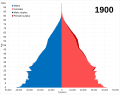 Switzerland population pyramid in 1900
 -
 Switzerland population pyramid in 2000
 -
 Switzerland population pyramid in 2100
 -
 Nigeria single age population pyramid 2020
 -
 Afghanistan single age population pyramid 2020
 -
 Ecuador single age population pyramid 2020
 -
 Italy Population Pyramid
 -
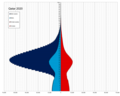 Qatar single age population pyramid 2020
 -
 2017 world map, median age by country
 -
 Total Fertility Rate Map by Country
 -
 Egypt population pyramid 2005


Ad. Transform your life with W8MD's Budget GLP-1 injections from $49.99


W8MD offers a medical weight loss program to lose weight in Philadelphia. Our physician-supervised medical weight loss provides:
- Weight loss injections in NYC (generic and brand names):
- Zepbound / Mounjaro, Wegovy / Ozempic, Saxenda
- Most insurances accepted or discounted self-pay rates. We will obtain insurance prior authorizations if needed.
- Generic GLP1 weight loss injections from $49.99 for the starting dose of Semaglutide and $65.00 for Tirzepatide.
- Also offer prescription weight loss medications including Phentermine, Qsymia, Diethylpropion, Contrave etc.
NYC weight loss doctor appointmentsNYC weight loss doctor appointments
Start your NYC weight loss journey today at our NYC medical weight loss and Philadelphia medical weight loss clinics.
- Call 718-946-5500 to lose weight in NYC or for medical weight loss in Philadelphia 215-676-2334.
- Tags:NYC medical weight loss, Philadelphia lose weight Zepbound NYC, Budget GLP1 weight loss injections, Wegovy Philadelphia, Wegovy NYC, Philadelphia medical weight loss, Brookly weight loss and Wegovy NYC


|
WikiMD's Wellness Encyclopedia |
| Let Food Be Thy Medicine Medicine Thy Food - Hippocrates |
Medical Disclaimer: WikiMD is not a substitute for professional medical advice. The information on WikiMD is provided as an information resource only, may be incorrect, outdated or misleading, and is not to be used or relied on for any diagnostic or treatment purposes. Please consult your health care provider before making any healthcare decisions or for guidance about a specific medical condition. WikiMD expressly disclaims responsibility, and shall have no liability, for any damages, loss, injury, or liability whatsoever suffered as a result of your reliance on the information contained in this site. By visiting this site you agree to the foregoing terms and conditions, which may from time to time be changed or supplemented by WikiMD. If you do not agree to the foregoing terms and conditions, you should not enter or use this site. See full disclaimer.
Credits:Most images are courtesy of Wikimedia commons, and templates, categories Wikipedia, licensed under CC BY SA or similar.
Translate this page: - East Asian
中文,
日本,
한국어,
South Asian
हिन्दी,
தமிழ்,
తెలుగు,
Urdu,
ಕನ್ನಡ,
Southeast Asian
Indonesian,
Vietnamese,
Thai,
မြန်မာဘာသာ,
বাংলা
European
español,
Deutsch,
français,
Greek,
português do Brasil,
polski,
română,
русский,
Nederlands,
norsk,
svenska,
suomi,
Italian
Middle Eastern & African
عربى,
Turkish,
Persian,
Hebrew,
Afrikaans,
isiZulu,
Kiswahili,
Other
Bulgarian,
Hungarian,
Czech,
Swedish,
മലയാളം,
मराठी,
ਪੰਜਾਬੀ,
ગુજરાતી,
Portuguese,
Ukrainian
