Nucleic acid analogue
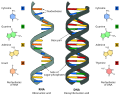
Nucleic acid analogues are compounds structurally similar to naturally occurring RNA and DNA, but have been altered chemically. These analogues can be used in research and therapy, offering insights into the genetic control mechanisms of cells and serving as tools or drugs in the treatment of viral and genetic diseases.
Overview
Nucleic acid analogues are designed to mimic the essential properties of natural nucleic acids but with modifications that confer specific advantages, such as increased stability against enzymatic degradation or the ability to bind more selectively to certain nucleic acid sequences. These modifications can include changes to the sugar moiety, such as in the case of locked nucleic acids (LNAs), or alterations to the bases themselves, leading to the creation of base analogues.
Applications
Research
In research, nucleic acid analogues are invaluable tools for studying the functions and structures of genes and RNA molecules. They are used in techniques such as molecular cloning and PCR (Polymerase Chain Reaction) to introduce mutations, inhibit specific gene expressions, or to study the mechanisms of gene regulation.
Therapeutics
Therapeutically, nucleic acid analogues have been developed to treat a variety of diseases, including viral infections and genetic disorders. For example, certain analogues are used as antiviral agents against HIV and Hepatitis B by inhibiting the viral DNA polymerase, thus preventing viral replication. In the context of genetic disorders, analogues can be designed to target and modulate the expression of specific genes, offering potential treatments for diseases like cystic fibrosis and Duchenne muscular dystrophy.
Types of Nucleic Acid Analogues
There are several types of nucleic acid analogues, each with specific characteristics and applications:
- Phosphorothioate oligonucleotides: These contain a sulfur atom replacing one of the non-bridging oxygen atoms in the phosphate backbone, enhancing their stability.
- Peptide Nucleic Acids (PNAs): PNAs have a peptide-like backbone instead of a sugar-phosphate one, offering stronger binding to DNA and RNA targets and resistance to enzymatic degradation.
- Locked Nucleic Acids (LNAs): LNAs contain a modified ribose ring that locks the structure into a rigid conformation, increasing affinity for target RNA and DNA.
- Morpholino oligomers: These are used to block small, specific sequences of RNA, preventing translation and thus expression of the target protein.
Challenges and Future Directions
While nucleic acid analogues hold great promise for research and therapy, there are challenges to their use, including delivery to specific cells or tissues, potential off-target effects, and the stability of these compounds in the biological environment. Ongoing research aims to address these issues, with the development of more sophisticated delivery mechanisms and the design of analogues with improved specificity and reduced toxicity.
See Also

-
 Nucleic acid analogue
 -
 Nucleic acid analogue
 -
 Nucleic acid analogue
 -
 Nucleic acid analogue
 -
 Nucleic acid analogue
 -
 Nucleic acid analogue
 -
 Nucleic acid analogue
 -
 Nucleic acid analogue
 -
 Nucleic acid analogue
 -
 Nucleic acid analogue
 -
 Nucleic acid analogue
 -
 Nucleic acid analogue


Ad. Transform your life with W8MD's
GLP-1 weight loss injections special from $29.99 with insurance
|
WikiMD Medical Encyclopedia |
Medical Disclaimer: WikiMD is for informational purposes only and is not a substitute for professional medical advice. Content may be inaccurate or outdated and should not be used for diagnosis or treatment. Always consult your healthcare provider for medical decisions. Verify information with trusted sources such as CDC.gov and NIH.gov. By using this site, you agree that WikiMD is not liable for any outcomes related to its content. See full disclaimer.
Credits:Most images are courtesy of Wikimedia commons, and templates, categories Wikipedia, licensed under CC BY SA or similar.
Translate this page: - East Asian
中文,
日本,
한국어,
South Asian
हिन्दी,
தமிழ்,
తెలుగు,
Urdu,
ಕನ್ನಡ,
Southeast Asian
Indonesian,
Vietnamese,
Thai,
မြန်မာဘာသာ,
বাংলা
European
español,
Deutsch,
français,
Greek,
português do Brasil,
polski,
română,
русский,
Nederlands,
norsk,
svenska,
suomi,
Italian
Middle Eastern & African
عربى,
Turkish,
Persian,
Hebrew,
Afrikaans,
isiZulu,
Kiswahili,
Other
Bulgarian,
Hungarian,
Czech,
Swedish,
മലയാളം,
मराठी,
ਪੰਜਾਬੀ,
ગુજરાતી,
Portuguese,
Ukrainian
