Burlesque
Burlesque[edit]
Burlesque is a literary, dramatic, or musical work intended to cause laughter by caricaturing the manner or spirit of serious works, or by ludicrous treatment of their subjects. The word derives from the Italian burlesco, which, in turn, is derived from burla – a joke, ridicule, or mockery.
History[edit]
Burlesque has a long history, dating back to the 17th century. It was originally a form of parody that mocked the serious works of art, literature, and music of the time. In the 19th century, burlesque became a popular form of entertainment in Europe and America, often featuring comedic sketches, musical numbers, and dance routines.
17th and 18th Century[edit]
In the 17th and 18th centuries, burlesque was primarily a literary form. Writers such as Alexander Pope and Jonathan Swift used burlesque to satirize the politics and society of their time. These works often employed a high style to describe trivial or ridiculous subjects, creating a humorous contrast.
19th Century[edit]
In the 19th century, burlesque evolved into a theatrical form. It became popular in Victorian England and the United States, where it was known for its variety shows that included comedy, music, and dance. Notable performers of this era included Lydia Thompson and her "British Blondes," who brought burlesque to America in the 1860s.
Modern Burlesque[edit]
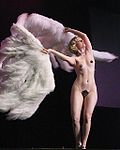
Modern burlesque has seen a revival since the late 20th century, often referred to as "neo-burlesque." This form retains the humor and parody of traditional burlesque but often incorporates elements of striptease and performance art. Performers such as Dita Von Teese have popularized this modern interpretation.
Characteristics[edit]
Burlesque is characterized by its use of humor, parody, and exaggeration. It often involves:
- Parody: Imitating and exaggerating the style of a particular genre or work.
- Exaggeration: Over-the-top performances and costumes.
- Music and Dance: Incorporating musical numbers and dance routines.
- Comedy: Using humor to entertain and engage the audience.
Influence and Legacy[edit]
Burlesque has influenced many forms of entertainment, including vaudeville, cabaret, and modern comedy. Its legacy can be seen in the way it has shaped the development of these genres, particularly in its use of satire and parody.
Notable Figures[edit]
See Also[edit]
References[edit]
- Allen, Robert Clyde. Horrible Prettiness: Burlesque and American Culture. University of North Carolina Press, 1991.
- Baldwin, Michelle. Burlesque and the New Bump-n-Grind. Speck Press, 2004.
External Links[edit]
-
 Burlesque
 -
 Burlesque
 -
 Burlesque
 -
 Burlesque
 -
Burlesque
-
 Burlesque
 -
 Burlesque
 -
 Burlesque
 -
 Burlesque


Ad. Transform your health with W8MD Weight Loss, Sleep & MedSpa

Tired of being overweight?
Special offer:
Budget GLP-1 weight loss medications
- Semaglutide starting from $29.99/week and up with insurance for visit of $59.99 and up per week self pay.
- Tirzepatide starting from $45.00/week and up (dose dependent) or $69.99/week and up self pay
✔ Same-week appointments, evenings & weekends
Learn more:
- GLP-1 weight loss clinic NYC
- W8MD's NYC medical weight loss
- W8MD Philadelphia GLP-1 shots
- Philadelphia GLP-1 injections
- Affordable GLP-1 shots NYC
|
WikiMD Medical Encyclopedia |
Medical Disclaimer: WikiMD is for informational purposes only and is not a substitute for professional medical advice. Content may be inaccurate or outdated and should not be used for diagnosis or treatment. Always consult your healthcare provider for medical decisions. Verify information with trusted sources such as CDC.gov and NIH.gov. By using this site, you agree that WikiMD is not liable for any outcomes related to its content. See full disclaimer.
Credits:Most images are courtesy of Wikimedia commons, and templates, categories Wikipedia, licensed under CC BY SA or similar.
Translate this page: - East Asian
中文,
日本,
한국어,
South Asian
हिन्दी,
தமிழ்,
తెలుగు,
Urdu,
ಕನ್ನಡ,
Southeast Asian
Indonesian,
Vietnamese,
Thai,
မြန်မာဘာသာ,
বাংলা
European
español,
Deutsch,
français,
Greek,
português do Brasil,
polski,
română,
русский,
Nederlands,
norsk,
svenska,
suomi,
Italian
Middle Eastern & African
عربى,
Turkish,
Persian,
Hebrew,
Afrikaans,
isiZulu,
Kiswahili,
Other
Bulgarian,
Hungarian,
Czech,
Swedish,
മലയാളം,
मराठी,
ਪੰਜਾਬੀ,
ગુજરાતી,
Portuguese,
Ukrainian

