Papanicolaou stain
Papanicolaou stain (also known as Pap stain) is a multi-chromatic staining cytological technique developed by Dr. George Papanicolaou, a Greek pioneer in cytopathology and early cancer detection. This staining method is used worldwide for the early detection of cancer and other diseases in cells, particularly those from the cervix.
History[edit]
The Papanicolaou stain was developed by George Papanicolaou, a Greek physician, in the early 20th century. Papanicolaou's work revolutionized the early detection of cancer, particularly cervical cancer, and has saved countless lives.
Method[edit]
The Papanicolaou stain involves a complex sequence of steps and uses multiple stains to highlight different parts of the cell. The process begins with the collection of cells, which are then fixed and stained. The staining process involves the use of hematoxylin to stain the cell nuclei, and orange G and EA (eosin azure) to stain the cytoplasm.
Uses[edit]
The primary use of the Papanicolaou stain is in Pap tests, where it is used to examine cells from the cervix for signs of precancerous or cancerous changes. It is also used in other types of cytological studies, such as pleural fluid or urine tests, where it can help identify abnormal cells.
Advantages and Disadvantages[edit]
The Papanicolaou stain offers several advantages, including its ability to highlight different parts of the cell and its effectiveness in identifying abnormal cells. However, it also has some disadvantages, such as the complexity of the staining process and the need for specialized training to interpret the results.
See Also[edit]
References[edit]
<references />
 | |
|---|---|
 |
 |
-
 Low-grade squamous intraepithelial lesion
 -
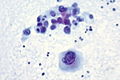 Malignant Melanoma, Liver FNA, Direct Smear, Pap Stain
 -
 Squamous Cell Carcinoma, Bronchial Washing, Pap Stain
 -
 Papillary Thyroid Carcinoma, FNA, Pap stain
 -
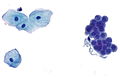 Benign urine cytology
 -
 Squamous cell carcinoma in the cervix, pap stain

.jpg)
.jpg)
.jpg)


Ad. Transform your life with W8MD's
GLP-1 weight loss injections special from $29.99 with insurance
|
WikiMD Medical Encyclopedia |
Medical Disclaimer: WikiMD is for informational purposes only and is not a substitute for professional medical advice. Content may be inaccurate or outdated and should not be used for diagnosis or treatment. Always consult your healthcare provider for medical decisions. Verify information with trusted sources such as CDC.gov and NIH.gov. By using this site, you agree that WikiMD is not liable for any outcomes related to its content. See full disclaimer.
Credits:Most images are courtesy of Wikimedia commons, and templates, categories Wikipedia, licensed under CC BY SA or similar.
Translate this page: - East Asian
中文,
日本,
한국어,
South Asian
हिन्दी,
தமிழ்,
తెలుగు,
Urdu,
ಕನ್ನಡ,
Southeast Asian
Indonesian,
Vietnamese,
Thai,
မြန်မာဘာသာ,
বাংলা
European
español,
Deutsch,
français,
Greek,
português do Brasil,
polski,
română,
русский,
Nederlands,
norsk,
svenska,
suomi,
Italian
Middle Eastern & African
عربى,
Turkish,
Persian,
Hebrew,
Afrikaans,
isiZulu,
Kiswahili,
Other
Bulgarian,
Hungarian,
Czech,
Swedish,
മലയാളം,
मराठी,
ਪੰਜਾਬੀ,
ગુજરાતી,
Portuguese,
Ukrainian
