Carbonic anhydrase
Carbonic anhydrase is a family of enzymes that catalyze the rapid interconversion of carbon dioxide and water to bicarbonate and protons (or vice versa), a reaction that occurs rather slowly in the absence of a catalyst.
Function[edit]
Carbonic anhydrase helps regulate pH and fluid balance in various parts of the body. It is found in a variety of tissues, including red blood cells, the kidneys, and the eyes. In the kidney, it helps reabsorb bicarbonate, a key component of the blood buffer system. In the eye, it helps produce aqueous humor, the fluid that fills the anterior chamber of the eye.
Types[edit]
There are several types of carbonic anhydrase, which are classified based on their structural characteristics. These include:
- Carbonic anhydrase I (CA I), which is found primarily in red blood cells.
- Carbonic anhydrase II (CA II), which is found in many tissues, including the kidneys and the eyes.
- Carbonic anhydrase III (CA III), which is found in skeletal muscle.
- Carbonic anhydrase IV (CA IV), which is found on the surface of endothelial cells in the lungs and kidneys.
Clinical significance[edit]
Mutations in the genes that encode carbonic anhydrase can lead to a variety of disorders. For example, mutations in the gene for CA II can cause osteopetrosis (a condition characterized by dense, brittle bones), renal tubular acidosis (a condition characterized by acidic blood), and cerebral calcification (a condition characterized by calcium deposits in the brain).
Inhibitors of carbonic anhydrase, such as acetazolamide, are used to treat conditions such as glaucoma, epilepsy, and altitude sickness.
See also[edit]
References[edit]
<references />
 | |
|---|---|
 |
 |
-
 Human carbonic anhydrase II structure
 -
 Mechanism of carbonic anhydrase II
 -
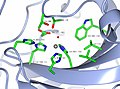 Active site of carbonic anhydrase II
 -
 Active site of carbonic anhydrase 1CA2
 -
 Carbonic anhydrase II enzyme
 -
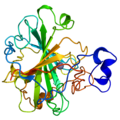 Structure of carbonic anhydrase 1CA2
 -
 Ligands and pocket style of carbonic anhydrase


.jpg)


Ad. Transform your life with W8MD's
GLP-1 weight loss injections special from $29.99 with insurance
|
WikiMD Medical Encyclopedia |
Medical Disclaimer: WikiMD is for informational purposes only and is not a substitute for professional medical advice. Content may be inaccurate or outdated and should not be used for diagnosis or treatment. Always consult your healthcare provider for medical decisions. Verify information with trusted sources such as CDC.gov and NIH.gov. By using this site, you agree that WikiMD is not liable for any outcomes related to its content. See full disclaimer.
Credits:Most images are courtesy of Wikimedia commons, and templates, categories Wikipedia, licensed under CC BY SA or similar.
Translate this page: - East Asian
中文,
日本,
한국어,
South Asian
हिन्दी,
தமிழ்,
తెలుగు,
Urdu,
ಕನ್ನಡ,
Southeast Asian
Indonesian,
Vietnamese,
Thai,
မြန်မာဘာသာ,
বাংলা
European
español,
Deutsch,
français,
Greek,
português do Brasil,
polski,
română,
русский,
Nederlands,
norsk,
svenska,
suomi,
Italian
Middle Eastern & African
عربى,
Turkish,
Persian,
Hebrew,
Afrikaans,
isiZulu,
Kiswahili,
Other
Bulgarian,
Hungarian,
Czech,
Swedish,
മലയാളം,
मराठी,
ਪੰਜਾਬੀ,
ગુજરાતી,
Portuguese,
Ukrainian
