Sporothrix schenckii
Sporothrix schenckii is a fungus that is the causative agent of Sporotrichosis, a disease primarily affecting the skin, bones, and sometimes the lungs. This fungus is found worldwide, particularly in soil, hay, sphagnum moss, and plants.
Taxonomy[edit]
Sporothrix schenckii belongs to the Ascomycota division of fungi, specifically within the Ophiostomatales order. It is the type species of the Sporothrix genus.
Morphology[edit]
Sporothrix schenckii is a dimorphic fungus, meaning it can exist in two different forms. At room temperature, it grows as a filamentous fungus, while at body temperature, it transforms into a yeast form.
Pathogenesis[edit]
The fungus enters the body through small cuts or punctures in the skin, often as a result of handling contaminated material. Once inside, it can cause a localized infection or spread to other parts of the body. The most common form of infection is cutaneous sporotrichosis, which presents as a chain of skin nodules or ulcers along the lymphatic vessels.
Diagnosis and Treatment[edit]
Diagnosis of Sporothrix schenckii infection is typically confirmed through culture of the fungus from a skin lesion. Treatment usually involves oral antifungal medication, such as itraconazole.
Epidemiology[edit]
Sporothrix schenckii is found worldwide, but is most common in tropical and subtropical regions. It is often associated with gardening, farming, and other activities that involve contact with soil and vegetation.
See also[edit]


-
 Conidiophores and conidia of the fungus Sporothrix schenckii
 -
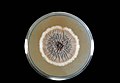 Sporothrix schenckii
 -
 Sporothrix schenckii conidia
 -
 Phase contrast micrograph of the yeast form of Sporothrix schenckii
 -
 Feline sporotrichosis
 -
 Polyketide Pathway Melanin Biosynthesis in Sporothrix schenckii


Ad. Transform your life with W8MD's
GLP-1 weight loss injections special from $29.99 with insurance
|
WikiMD Medical Encyclopedia |
Medical Disclaimer: WikiMD is for informational purposes only and is not a substitute for professional medical advice. Content may be inaccurate or outdated and should not be used for diagnosis or treatment. Always consult your healthcare provider for medical decisions. Verify information with trusted sources such as CDC.gov and NIH.gov. By using this site, you agree that WikiMD is not liable for any outcomes related to its content. See full disclaimer.
Credits:Most images are courtesy of Wikimedia commons, and templates, categories Wikipedia, licensed under CC BY SA or similar.
Translate this page: - East Asian
中文,
日本,
한국어,
South Asian
हिन्दी,
தமிழ்,
తెలుగు,
Urdu,
ಕನ್ನಡ,
Southeast Asian
Indonesian,
Vietnamese,
Thai,
မြန်မာဘာသာ,
বাংলা
European
español,
Deutsch,
français,
Greek,
português do Brasil,
polski,
română,
русский,
Nederlands,
norsk,
svenska,
suomi,
Italian
Middle Eastern & African
عربى,
Turkish,
Persian,
Hebrew,
Afrikaans,
isiZulu,
Kiswahili,
Other
Bulgarian,
Hungarian,
Czech,
Swedish,
മലയാളം,
मराठी,
ਪੰਜਾਬੀ,
ગુજરાતી,
Portuguese,
Ukrainian
