Walking bus
Walking Bus
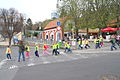
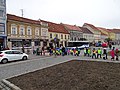
A Walking Bus is an organized group of children walking to school, with one or more adults leading the way. The concept mimics a traditional bus route, where children are picked up and dropped off at designated "bus stops" along a set route. The primary aim of a Walking Bus is to improve child safety by providing adult supervision on the journey to and from school. Additionally, it promotes physical activity, reduces traffic congestion around school areas, and minimizes environmental pollution from vehicle emissions.
Origins and Development[edit]
The Walking Bus concept originated in the late 1990s as a response to growing concerns over children's safety on their way to school and the increasing levels of air pollution and traffic congestion near schools. It was also seen as a way to combat the declining levels of physical activity among children. The idea quickly spread from its place of origin to various countries around the world, adapting to local needs and regulations.
Structure and Operation[edit]
A typical Walking Bus operates with a clear set of rules and a predetermined route. Volunteers, often parents or teachers, undergo safety training and are assigned roles as "drivers" or "conductors" to lead and follow the group, ensuring all children stay on the path and cross roads safely. The route and stops are carefully chosen to maximize safety and efficiency, taking into consideration factors such as pedestrian pathways, crosswalks, and traffic lights.
Safety Measures[edit]
Safety is a paramount concern for Walking Buses. Measures include high-visibility vests for children and adults, training for all volunteers on road safety, and sometimes background checks for adult volunteers. Parents are required to sign consent forms, and children are taught about pedestrian safety and the importance of following instructions.
Benefits[edit]
The Walking Bus offers multiple benefits:
- Child Safety: Reduces the risk of accidents by providing adult supervision.
- Physical Health': Encourages regular physical activity, contributing to overall health and fitness.
- Environmental Impact: Decreases the number of cars around schools, thus reducing air pollution and carbon footprint.
- Social Interaction: Fosters a sense of community and allows children to socialize outside the classroom.
Challenges[edit]
Despite its benefits, the Walking Bus faces challenges such as recruiting and retaining enough adult volunteers, dealing with inclement weather, and ensuring the safety of children from external threats. Additionally, logistical issues such as coordinating times and routes can be complex.
Global Adoption[edit]
The Walking Bus concept has been adopted and adapted worldwide, with variations in operation based on local laws, culture, and infrastructure. Some countries have integrated technology, using apps for coordination and communication among parents and volunteers.
Conclusion[edit]
The Walking Bus is a simple yet effective initiative that addresses multiple issues related to children's journey to school. By promoting walking in a safe and supervised manner, it contributes to the physical well-being of children, reduces environmental impact, and enhances community engagement. As urban areas continue to grow and seek sustainable solutions to traffic and pollution, the Walking Bus represents a model of community-led action with significant benefits.

-
 Walking bus
 -
 Walking bus
 -
 Walking bus stop sign
 -
 Walking bus sign
 -
 Pedibus stop sign
 -
 Bike to School Day


.jpg)
Ad. Transform your life with W8MD's
GLP-1 weight loss injections special from $29.99


W8MD Medical Weight Loss, Sleep and Medspa offers physician-supervised medical weight loss programs: NYC medical weight loss Philadelphia medical weight loss
Affordable GLP-1 Weight Loss ShotsAffordable GLP-1 Weight Loss Shots
Budget GLP-1 injections NYC (insurance & self-pay options) Popular treatments:
- Semaglutide starting from $29.99/week
- Tirzepatide starting from $45.00/week
✔ Most insurances accepted for visits ✔ Prior authorization support when eligible
Start your physician weight loss NYC journey today:
📍 NYC: Brooklyn weight loss center 📍 Philadelphia: Philadelphia weight loss center
📞 Call: 718-946-5500 (NYC) | 215-676-2334 (Philadelphia)
Tags: Affordable GLP1 weight loss NYC, Wegovy NYC, Zepbound NYC, Philadelphia medical weight loss


|
WikiMD Medical Encyclopedia |
Medical Disclaimer: WikiMD is not a substitute for professional medical advice. The information on WikiMD is provided as an information resource only, may be incorrect, outdated or misleading, and is not to be used or relied on for any diagnostic or treatment purposes. Please consult your health care provider before making any healthcare decisions or for guidance about a specific medical condition. WikiMD expressly disclaims responsibility, and shall have no liability, for any damages, loss, injury, or liability whatsoever suffered as a result of your reliance on the information contained in this site. By visiting this site you agree to the foregoing terms and conditions, which may from time to time be changed or supplemented by WikiMD. If you do not agree to the foregoing terms and conditions, you should not enter or use this site. See full disclaimer.
Credits:Most images are courtesy of Wikimedia commons, and templates, categories Wikipedia, licensed under CC BY SA or similar.
Translate this page: - East Asian
中文,
日本,
한국어,
South Asian
हिन्दी,
தமிழ்,
తెలుగు,
Urdu,
ಕನ್ನಡ,
Southeast Asian
Indonesian,
Vietnamese,
Thai,
မြန်မာဘာသာ,
বাংলা
European
español,
Deutsch,
français,
Greek,
português do Brasil,
polski,
română,
русский,
Nederlands,
norsk,
svenska,
suomi,
Italian
Middle Eastern & African
عربى,
Turkish,
Persian,
Hebrew,
Afrikaans,
isiZulu,
Kiswahili,
Other
Bulgarian,
Hungarian,
Czech,
Swedish,
മലയാളം,
मराठी,
ਪੰਜਾਬੀ,
ગુજરાતી,
Portuguese,
Ukrainian
