Supinator muscle
Supinator muscle is a muscle in the forearm that plays a crucial role in the rotation of the forearm and hand. It is one of the key muscles involved in the supination of the forearm, which is the action of turning the palm upward or forward.
Etymology[edit]
The term "supinator" comes from the Latin word "supinare", which means "to lay on the back". This is in reference to the action of the muscle, which turns the palm upward as if laying on one's back.
Anatomy[edit]
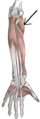
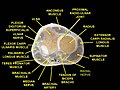
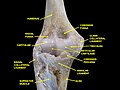
The supinator muscle is located in the posterior compartment of the forearm, lateral to the elbow joint. It originates from the lateral epicondyle of the humerus, the radial collateral ligament, the annular ligament, and the supinator fossa and crest of the ulna. It inserts into the lateral, posterior, and anterior surfaces of the proximal third of the radius.
Function[edit]
The primary function of the supinator muscle is to supinate the forearm, which is the action of turning the palm upward or forward. This is an essential movement for many daily activities, such as turning a doorknob or using a screwdriver. The supinator muscle also assists in elbow flexion.
Clinical significance[edit]
Injury or damage to the supinator muscle can result in loss of supination, which can significantly impact daily activities. Conditions such as supinator syndrome or radial tunnel syndrome can cause pain and weakness in the supinator muscle. Treatment typically involves physical therapy, medication, and in severe cases, surgery.
Related terms[edit]
- Pronator teres muscle: A muscle in the forearm that performs the opposite action of the supinator muscle, pronating the forearm.
- Biceps brachii muscle: A muscle in the upper arm that also assists in the supination of the forearm.
 | This medical article is a stub. You can help WikiMD by expanding the page. |
-
 Supinator muscle
 -
 Supinator muscle
 -
 Supinator muscle
 -
 Supinator muscle
 -
 Supinator muscle
 -
 Supinator muscle
 -
 Supinator muscle
 -
 Supinator muscle
 -
 Supinator muscle
 -
 Supinator muscle


.jpg)
.jpg)
Medical Disclaimer: WikiMD is for informational purposes only and is not a substitute for professional medical advice. Content may be inaccurate or outdated and should not be used for diagnosis or treatment. Always consult your healthcare provider for medical decisions. Verify information with trusted sources such as CDC.gov and NIH.gov. By using this site, you agree that WikiMD is not liable for any outcomes related to its content. See full disclaimer.
Credits:Most images are courtesy of Wikimedia commons, and templates, categories Wikipedia, licensed under CC BY SA or similar.
Translate this page: - East Asian
中文,
日本,
한국어,
South Asian
हिन्दी,
தமிழ்,
తెలుగు,
Urdu,
ಕನ್ನಡ,
Southeast Asian
Indonesian,
Vietnamese,
Thai,
မြန်မာဘာသာ,
বাংলা
European
español,
Deutsch,
français,
Greek,
português do Brasil,
polski,
română,
русский,
Nederlands,
norsk,
svenska,
suomi,
Italian
Middle Eastern & African
عربى,
Turkish,
Persian,
Hebrew,
Afrikaans,
isiZulu,
Kiswahili,
Other
Bulgarian,
Hungarian,
Czech,
Swedish,
മലയാളം,
मराठी,
ਪੰਜਾਬੀ,
ગુજરાતી,
Portuguese,
Ukrainian
