Natural satellite
Natural satellite
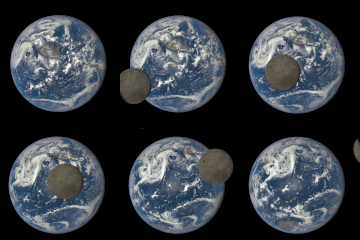
A natural satellite or moon is an astronomical body that orbits a planet or a minor planet (or sometimes another small Solar System body). In the Solar System, there are six planetary satellite systems containing 205 known natural satellites. Earth's Moon is the fifth largest of the various moons and the most well-known, due to its close proximity to Earth.
Formation and characteristics[edit]
Natural satellites can form through several mechanisms. The most common theory suggests they form from accretion disks of material orbiting a planet, similar to how planets form around stars. Other theories propose that they may be captured objects from the surrounding space, remnants of a larger body that was shattered by impacts, or the result of a collision between a planet and another object, where the debris from such an event coalesces into a satellite.
Natural satellites vary greatly in size, composition, and origin. Their compositions can range from dense rocky bodies, like Earth's Moon, to icy bodies with subsurface oceans, such as Saturn's moon Enceladus, or even captured asteroids, like Mars' moons Phobos and Deimos. The characteristics of a moon can provide valuable insights into the history and evolution of its parent planet.
Orbital characteristics[edit]
The orbits of natural satellites are determined by the interplay of gravity between the moon, its parent planet, and the Sun. These orbits can be nearly circular or highly elliptical, and their orientation can lead to various phenomena, such as eclipses, transits, and occultations. Some moons have synchronous rotation, meaning they show the same face to their parent planet, as is the case with Earth's Moon.
Significance[edit]
Natural satellites have significant effects on their parent planets. They can affect planetary rotation, shape climate patterns, and influence geological activity. For example, the gravitational pull of Earth's Moon causes ocean tides. In some cases, the interaction between a planet and its moons can lead to tidal heating, driving geological activity, as seen on Jupiter's moon Io.
Exploration[edit]
The exploration of natural satellites has been a significant focus of space missions. These missions have ranged from flybys and orbiters to landers and rovers. The data collected from these missions have greatly enhanced our understanding of the Solar System, including the discovery of subsurface oceans on moons like Europa and Enceladus, which are considered potential habitats for extraterrestrial life.
List of notable natural satellites[edit]
- Earth's Moon – The only moon with a human presence to date.
- Ganymede – The largest moon in the Solar System, orbiting Jupiter.
- Titan – Saturn's largest moon, notable for its dense atmosphere and liquid hydrocarbon lakes.
- Io – A volcanically active moon of Jupiter.
- Europa – An icy moon of Jupiter, believed to harbor a subsurface ocean.
- Enceladus – A small moon of Saturn, known for its geysers ejecting water vapor and organic compounds.
See also[edit]

-
 Natural_satellite
 -
 Moon and Earth size comparison
 -
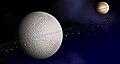 Rhea's rings
 -
 Masses of all moons
 -
 Methone
 -
 Moons of the Solar System to scale


.png)
Ad. Transform your life with W8MD's
GLP-1 weight loss injections special from $29.99 with insurance
|
WikiMD Medical Encyclopedia |
Medical Disclaimer: WikiMD is for informational purposes only and is not a substitute for professional medical advice. Content may be inaccurate or outdated and should not be used for diagnosis or treatment. Always consult your healthcare provider for medical decisions. Verify information with trusted sources such as CDC.gov and NIH.gov. By using this site, you agree that WikiMD is not liable for any outcomes related to its content. See full disclaimer.
Credits:Most images are courtesy of Wikimedia commons, and templates, categories Wikipedia, licensed under CC BY SA or similar.
Translate this page: - East Asian
中文,
日本,
한국어,
South Asian
हिन्दी,
தமிழ்,
తెలుగు,
Urdu,
ಕನ್ನಡ,
Southeast Asian
Indonesian,
Vietnamese,
Thai,
မြန်မာဘာသာ,
বাংলা
European
español,
Deutsch,
français,
Greek,
português do Brasil,
polski,
română,
русский,
Nederlands,
norsk,
svenska,
suomi,
Italian
Middle Eastern & African
عربى,
Turkish,
Persian,
Hebrew,
Afrikaans,
isiZulu,
Kiswahili,
Other
Bulgarian,
Hungarian,
Czech,
Swedish,
മലയാളം,
मराठी,
ਪੰਜਾਬੀ,
ગુજરાતી,
Portuguese,
Ukrainian
