Photostimulated luminescence
Photostimulated luminescence (PSL) is a form of luminescence that is initiated or enhanced by the absorption of electromagnetic radiation, where the material emits light upon stimulation by a light source after it has absorbed energy. This phenomenon is distinct from fluorescence and phosphorescence in terms of the mechanism and the duration of the emitted light. PSL has significant applications in various fields, including medical imaging, radiation dosimetry, and data storage.
Overview[edit]
Photostimulated luminescence occurs when a material that has absorbed energy from ionizing radiation (such as X-rays, gamma rays, or ultraviolet light) is subsequently exposed to a stimulating light source, usually in the visible spectrum. The absorbed energy is stored in the form of trapped electrons or holes in the crystal lattice of the material. When the material is exposed to light, these trapped charges are released and recombine, emitting light in the process. The intensity of the emitted light is proportional to the amount of stored energy, making PSL useful for quantitative measurements of radiation exposure.
Mechanism[edit]
The mechanism of photostimulated luminescence involves three main steps:
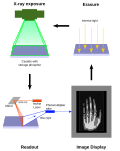
- Energy Absorption: The material absorbs ionizing radiation, leading to the excitation of electrons to higher energy states and their subsequent trapping in the crystal lattice.
- Stimulation: Exposure to a stimulating light source (often a laser) provides the energy required to release the trapped electrons.
- Emission: The released electrons recombine with holes, resulting in the emission of light as they return to their ground state.
Materials[edit]
Common materials used for PSL include alkali halides, such as sodium chloride (NaCl) and cesium iodide (CsI), and phosphors containing europium or thulium. These materials are chosen for their ability to efficiently trap and store energy and for their strong luminescence upon stimulation.
Applications[edit]
- Medical Imaging
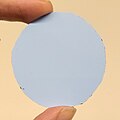
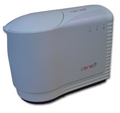
In medical imaging, particularly in digital X-ray imaging and computed radiography (CR), PSL is used to capture and store the image information. The imaging plates used in CR are coated with photostimulable phosphors that store the energy from X-ray exposure. When scanned with a laser, the stored image is released as light and captured by a photodetector, then converted into a digital image.
- Radiation Dosimetry
PSL is also employed in radiation dosimetry for measuring doses of ionizing radiation. PSL dosimeters are used in various settings, including medical, industrial, and environmental monitoring, to assess exposure to radiation.
- Data Storage
In the field of data storage, PSL technology is explored for high-density optical storage. Information can be written onto a photostimulable material using a high-intensity light source and later read out by stimulating the material with a lower-intensity light, causing it to emit light proportional to the stored data.
Advantages and Limitations[edit]
The main advantages of photostimulated luminescence include its high sensitivity to radiation, the ability to precisely measure radiation doses, and the non-destructive readout process. However, limitations include the need for specialized equipment for stimulation and readout, potential fading of the stored signal over time, and the influence of ambient conditions on the material's performance.


-
 Photostimulated luminescence
 -
 Photostimulated luminescence
 -
 Photostimulated luminescence
 -
 Photostimulated luminescence
 -
 Photostimulated luminescence


Ad. Transform your health with W8MD Weight Loss, Sleep & MedSpa

Tired of being overweight?
Special offer:
Budget GLP-1 weight loss medications
- Semaglutide starting from $29.99/week and up with insurance for visit of $59.99 and up per week self pay.
- Tirzepatide starting from $45.00/week and up (dose dependent) or $69.99/week and up self pay
✔ Same-week appointments, evenings & weekends
Learn more:
- GLP-1 weight loss clinic NYC
- W8MD's NYC medical weight loss
- W8MD Philadelphia GLP-1 shots
- Philadelphia GLP-1 injections
- Affordable GLP-1 shots NYC
|
WikiMD Medical Encyclopedia |
Medical Disclaimer: WikiMD is for informational purposes only and is not a substitute for professional medical advice. Content may be inaccurate or outdated and should not be used for diagnosis or treatment. Always consult your healthcare provider for medical decisions. Verify information with trusted sources such as CDC.gov and NIH.gov. By using this site, you agree that WikiMD is not liable for any outcomes related to its content. See full disclaimer.
Credits:Most images are courtesy of Wikimedia commons, and templates, categories Wikipedia, licensed under CC BY SA or similar.
Translate this page: - East Asian
中文,
日本,
한국어,
South Asian
हिन्दी,
தமிழ்,
తెలుగు,
Urdu,
ಕನ್ನಡ,
Southeast Asian
Indonesian,
Vietnamese,
Thai,
မြန်မာဘာသာ,
বাংলা
European
español,
Deutsch,
français,
Greek,
português do Brasil,
polski,
română,
русский,
Nederlands,
norsk,
svenska,
suomi,
Italian
Middle Eastern & African
عربى,
Turkish,
Persian,
Hebrew,
Afrikaans,
isiZulu,
Kiswahili,
Other
Bulgarian,
Hungarian,
Czech,
Swedish,
മലയാളം,
मराठी,
ਪੰਜਾਬੀ,
ગુજરાતી,
Portuguese,
Ukrainian
