Deep branch of radial nerve
Deep branch of the radial nerve (also known as the posterior interosseous nerve) is a significant nerve in the human forearm. It is one of the two terminal branches of the radial nerve, a major nerve of the upper limb that arises from the brachial plexus. The deep branch primarily innervates the extensor muscles of the forearm, playing a crucial role in the extension of the wrist and fingers. Understanding its anatomy, functions, and clinical significance is essential for medical professionals and students.
Anatomy[edit]
The radial nerve divides into the deep and superficial branches in the cubital fossa, an area of the elbow. The deep branch of the radial nerve pierces the supinator muscle and continues into the posterior compartment of the forearm, where it is renamed the posterior interosseous nerve. This nerve travels along the interosseous membrane, which separates the forearm's anterior and posterior compartments, providing motor innervation to several muscles.
Branches and Innervation[edit]
The deep branch of the radial nerve innervates the following muscles in the forearm:
- Supinator
- Extensor carpi radialis brevis
- Extensor digitorum
- Extensor digiti minimi
- Extensor carpi ulnaris
- Abductor pollicis longus
- Extensor pollicis brevis
- Extensor pollicis longus
- Extensor indicis
These muscles are primarily responsible for extending the wrist and fingers, as well as abducting and extending the thumb.
Function[edit]
The primary function of the deep branch of the radial nerve is to control the extension of the wrist and fingers, which is essential for many daily activities and precise movements. It also contributes to the abduction and extension of the thumb, facilitating grip and manipulation of objects.
Clinical Significance[edit]
- Injury
Injury to the deep branch of the radial nerve can lead to a condition known as radial nerve palsy, characterized by a loss of ability to extend the wrist and fingers (wrist drop). This can result from various causes, including fracture of the radius bone, compression by the supinator muscle (supinator syndrome), or iatrogenic injury during surgical procedures.
- Diagnosis and Treatment
Diagnosis of deep branch radial nerve injury involves clinical examination and may be supported by electromyography (EMG) and nerve conduction studies. Treatment depends on the cause and severity of the injury and may include physical therapy, splinting, or surgical intervention to relieve nerve compression or repair nerve damage.
See Also[edit]
-
 Deep branch of radial nerve
 -
 Deep branch of radial nerve
 -
 Deep branch of radial nerve
 -
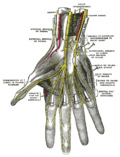 Deep branch of radial nerve


Ad. Transform your health with W8MD Weight Loss, Sleep & MedSpa

Tired of being overweight?
Special offer:
Budget GLP-1 weight loss medications
- Semaglutide starting from $29.99/week and up with insurance for visit of $59.99 and up per week self pay.
- Tirzepatide starting from $45.00/week and up (dose dependent) or $69.99/week and up self pay
✔ Same-week appointments, evenings & weekends
Learn more:
- GLP-1 weight loss clinic NYC
- W8MD's NYC medical weight loss
- W8MD Philadelphia GLP-1 shots
- Philadelphia GLP-1 injections
- Affordable GLP-1 shots NYC
|
WikiMD Medical Encyclopedia |
Medical Disclaimer: WikiMD is for informational purposes only and is not a substitute for professional medical advice. Content may be inaccurate or outdated and should not be used for diagnosis or treatment. Always consult your healthcare provider for medical decisions. Verify information with trusted sources such as CDC.gov and NIH.gov. By using this site, you agree that WikiMD is not liable for any outcomes related to its content. See full disclaimer.
Credits:Most images are courtesy of Wikimedia commons, and templates, categories Wikipedia, licensed under CC BY SA or similar.
Translate this page: - East Asian
中文,
日本,
한국어,
South Asian
हिन्दी,
தமிழ்,
తెలుగు,
Urdu,
ಕನ್ನಡ,
Southeast Asian
Indonesian,
Vietnamese,
Thai,
မြန်မာဘာသာ,
বাংলা
European
español,
Deutsch,
français,
Greek,
português do Brasil,
polski,
română,
русский,
Nederlands,
norsk,
svenska,
suomi,
Italian
Middle Eastern & African
عربى,
Turkish,
Persian,
Hebrew,
Afrikaans,
isiZulu,
Kiswahili,
Other
Bulgarian,
Hungarian,
Czech,
Swedish,
മലയാളം,
मराठी,
ਪੰਜਾਬੀ,
ગુજરાતી,
Portuguese,
Ukrainian
