National Maximum Speed Law
{{Infobox | child = | subbox = | above = National Maximum Speed Law | abovestyle = background-color: #ededed | headerstyle = background-color: #ededed |image = {{#if:|[[File:|image=|size=|sizedefault=frameless|upright=yes|alt=}}
|caption =
| labelstyle =
|header1 = United States Congress |data2 =
|label3 = Citation |data3 = |label4 = Territorial extent |data4 = |label5 = Considered by |data5 = |label6 = Enacted by |data6 = United States Congress |label7 = Passed |data7 = |label8 = Enacted |data8 = |label9 = Considered by |data9 = |label10 = Enacted by |data10 = |label11 = Passed |data11 = |label12 = Enacted |data12 = |label13 = Assented to by |data13 = |label14 = Assented to |data14 = |label15 = Royal assent |data15 = |label16 = Signed by |data16 = |label17 = Signed |data17 = |label18 = Vetoed by |data18 = |label19 = Vetoed |data19 = |label20 = Type of veto |data20 = |label21 = Veto overridden |data21 = |label22 = Holding |data22 = |label23 = Pocket vetoed |data23 = |label24 = Became law by inaction |data24 = |label25 = Commenced |data25 = |label26 = Effective |data26 = |label27 = Date of expiry |data27 = |label28 = Repealed |data28 = |label29 = Abrogated |data29 = |label30 = Authorizing legislation |data30 = |label31 = Administered by |data31 = |label32 = White paper |data32 =
|header33 = | label34 = Acts affected | data34 = | label35 = Acts amended | data35 = | label36 = Acts repealed | data36 = | label37 = Code titles affected | data37 = | label38 = Code titles amended | data38 = | label39 = Code sections created | data39 = | label40 = Code sections affected | data40 = | label41 = Code sections amended | data41 =
|header42 = |header43 = |label44 = Bill title |data44 = |label45 = Bill citation |data45 = |label46 = Introduced by |data46 = |label47 = Co-sponsored by |data47 = |label48 = Member in Charge |data48 = |label49 = Introduced |data49 = |label50 = Distributed to members |data50 = |label51 = Committee responsible |data51 = |label52 = Preliminary reading |data52 = | label53 = Voting summary | class53 = nowrap | data53 = |label54 = First reading |data54 = | label55 = Voting summary | class55 = nowrap | data55 = |label56 = Considered in committee |data56 = |label57 = Second reading |data57 = | label58 = Voting summary | class58 = nowrap | data58 = |label59 = Considered in committee |data59 = |label60 = Committee of the whole |data60 = |label61 = Third reading |data61 = | label62 = Voting summary | class62 = nowrap | data62 = |label63 = Passed |data63 = | label64 = Voting summary | class64 = nowrap | data64 = |label65 = Committee report |data65 = |header66 = |label67 = Bill title |data67 = |label68 = Bill citation |data68 = |label69 = Received from the |data69 = |label70 = Member(s) in charge |data70 = |label71 = Committee responsible |data71 = |label72 = Preliminary reading |data72 = | label73 = Voting summary | class73 = nowrap | data73 = |label74 = First reading |data74 = | label75 = Voting summary | class75 = nowrap | data75 = |label76 = Considered in committee |data76 = |label77 = Second reading |data77 = | label78 = Voting summary | class78 = nowrap | data78 = |label79 = Considered in committee |data79 = |label80 = Committee of the whole |data80 = |label81 = Third reading |data81 = | label82 = Voting summary | class82 = nowrap | data82 = |label83 = Passed |data83 = | label84 = Voting summary | class84 = nowrap | data84 = |label87 = Committee report |data87 = |header88 = |label91 = amendments considered by the United States Congress |data91 = | label92 = Voting summary | class92 = nowrap | data92 = |label93 = Reported from conference committee |data93 = |label94 = Conference committee bill passed by United States Congress |data94 = | label95 = Voting summary | class95 = nowrap | data95 = |label96 = Conference committee bill passed by |data96 = | label97 = Voting summary | class97 = nowrap | data97 = |label98 = Finally passed both chambers |data98 = |label99 = Reconsidered by the United States Congress after veto |data99 = | label100 = Voting summary | class100 = nowrap | data100 = |label101 = Reconsidered by the {{{considered_by2}}} after veto |data101 = | label102 = Voting summary | class102 = nowrap | data102 =
|header103 = |data104 =
|header105 = |data106 =
|header107 = |data108 =
|header109 = Repealed by |data110 = National Highway System Designation Act of 1995
|header111 = |data112 =
|header113 = |data114 =
|header115 = |data116 =
|header117 = |data118 =
|header119 = |data120 =
|header121 =
|belowstyle = background-color:transparent; border-top:#aaa 1px solid;; |below = }}
The National Maximum Speed Law was a United States federal law that imposed a national speed limit of 55 miles per hour (mph) on all major highways. Enacted by the United States Congress on January 2, 1974, the law aimed to conserve fuel during the 1973 oil crisis and reduce traffic fatalities.
Background[edit]
During the early 1970s, the United States faced an energy crisis due to the Organization of Arab Petroleum Exporting Countries (OAPEC) oil embargo. This led to a significant increase in fuel prices and shortages across the country. In response, the federal government implemented various measures to reduce fuel consumption, including the National Maximum Speed Law.
Enactment and Provisions[edit]
The National Maximum Speed Law was signed into law on January 2, 1974, by President Richard Nixon. The law established a maximum speed limit of 55 mph on all major highways, including interstate highways, across the United States. States were required to comply with this limit to receive federal funding for highway construction and maintenance.
Rationale and Objectives[edit]
The primary objective of the National Maximum Speed Law was to conserve fuel during the energy crisis. By reducing speeds, the law aimed to improve fuel efficiency and decrease overall fuel consumption. Additionally, proponents of the law argued that lower speeds would lead to a reduction in traffic accidents and fatalities.
Impact and Controversy[edit]
The National Maximum Speed Law had a significant impact on American society and transportation. While it successfully reduced fuel consumption by an estimated 2.2% to 3.1%, it also faced widespread criticism and controversy.
Opponents of the law argued that it infringed upon individual states' rights and personal freedoms. They claimed that the federal government should not dictate speed limits, as traffic conditions and road designs varied across states. Critics also contended that the law led to an increase in travel time, driver frustration, and aggressive driving behaviors.
Repeal and Legacy[edit]
The National Maximum Speed Law was repealed by the National Highway System Designation Act of 1995, signed into law on November 28, 1995, by President Bill Clinton. The act allowed states to set their own speed limits, resulting in the return of higher speed limits on many highways.
Despite its repeal, the National Maximum Speed Law left a lasting legacy. It highlighted the government's ability to regulate speed limits on a national scale and sparked debates on the balance between safety, fuel efficiency, and personal freedoms. The law also influenced subsequent transportation policies and speed limit regulations in the United States.
See Also[edit]
References[edit]
National Maximum Speed Law[edit]
-
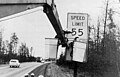 Workers erecting a 55 mph speed limit sign
 -
 Highway sign along Interstate 5 showing the 50 mph limit
 -
 Dashboard demonstration of 55 mph


Medical Disclaimer: WikiMD is for informational purposes only and is not a substitute for professional medical advice. Content may be inaccurate or outdated and should not be used for diagnosis or treatment. Always consult your healthcare provider for medical decisions. Verify information with trusted sources such as CDC.gov and NIH.gov. By using this site, you agree that WikiMD is not liable for any outcomes related to its content. See full disclaimer.
Credits:Most images are courtesy of Wikimedia commons, and templates, categories Wikipedia, licensed under CC BY SA or similar.
Translate this page: - East Asian
中文,
日本,
한국어,
South Asian
हिन्दी,
தமிழ்,
తెలుగు,
Urdu,
ಕನ್ನಡ,
Southeast Asian
Indonesian,
Vietnamese,
Thai,
မြန်မာဘာသာ,
বাংলা
European
español,
Deutsch,
français,
Greek,
português do Brasil,
polski,
română,
русский,
Nederlands,
norsk,
svenska,
suomi,
Italian
Middle Eastern & African
عربى,
Turkish,
Persian,
Hebrew,
Afrikaans,
isiZulu,
Kiswahili,
Other
Bulgarian,
Hungarian,
Czech,
Swedish,
മലയാളം,
मराठी,
ਪੰਜਾਬੀ,
ગુજરાતી,
Portuguese,
Ukrainian
