Dunning–Kruger effect
Dunning–Kruger effect is a cognitive bias in which people with low ability at a task overestimate their ability. It is related to the cognitive bias of illusory superiority and comes from the inability of people to recognize their lack of ability. Without the self-awareness of metacognition, people cannot objectively evaluate their competence or incompetence.
Origins[edit]
The phenomenon was first tested in a series of experiments in 1999 by David Dunning and Justin Kruger of the Department of Psychology at Cornell University. They were inspired by the case of McArthur Wheeler, a man who robbed banks while his face was covered with lemon juice, believing that because lemon juice is usable as invisible ink, it would prevent his face from being recorded on surveillance cameras. The researchers found that, in contrast to high performers, "poor performers—and only poor performers—grossly overestimated their performance and ability." Their results were published in the journal Psychological Science under the title "Unskilled and Unaware of It: How Difficulties in Recognizing One's Own Incompetence Lead to Inflated Self-Assessments."
Explanation[edit]
The Dunning–Kruger effect occurs where individuals fail to adequately assess their level of competence—or specifically, their incompetence—at a task and thus consider themselves much more competent than everyone else. This bias is attributed to a metacognitive inability of the unskilled to recognize their ineptitude. Conversely, highly competent individuals may underestimate their relative competence, presuming that tasks which are easy for them are also easy for others.
Dunning and Kruger proposed that, for a given skill, incompetent people will:
- Fail to recognize their own lack of skill
- Fail to recognize the extent of their inadequacy
- Fail to accurately gauge skill in others
- Recognize and acknowledge their own lack of skill only after they are exposed to training for that skill
Implications[edit]
The Dunning–Kruger effect has implications in many areas, including education, workplace performance, and social phenomena. In education, it highlights the importance of feedback and the potential pitfalls of self-assessment. In the workplace, it underscores the need for managerial awareness of employee competencies and the potential for overconfidence in tasks where individuals are not adequately skilled.
Criticism and Support[edit]
While the Dunning–Kruger effect has been replicated in various studies, it has also faced criticism. Some researchers argue that the effect is a statistical artifact of the low correlation between perceived and actual competence. Others suggest that studies confirming the Dunning–Kruger effect suffer from methodological issues.
Despite these criticisms, the concept of the Dunning–Kruger effect remains influential in psychology and popular culture, often cited to explain patterns of overconfidence in various settings.
See Also[edit]
References[edit]
<references/>

This article is a psychology-related stub. You can help WikiMD by expanding it!
-
 Graph illustrating the Dunning–Kruger effect
 -
 Dunning–Kruger effect shown with percentiles
 -
 Dunning–Kruger effect shown with raw scores
 -
 Simulation of the Dunning–Kruger effect
 -
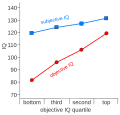 Another simulation of the Dunning–Kruger effect


Ad. Transform your life with W8MD's
GLP-1 weight loss injections special from $29.99 with insurance
|
WikiMD Medical Encyclopedia |
Medical Disclaimer: WikiMD is for informational purposes only and is not a substitute for professional medical advice. Content may be inaccurate or outdated and should not be used for diagnosis or treatment. Always consult your healthcare provider for medical decisions. Verify information with trusted sources such as CDC.gov and NIH.gov. By using this site, you agree that WikiMD is not liable for any outcomes related to its content. See full disclaimer.
Credits:Most images are courtesy of Wikimedia commons, and templates, categories Wikipedia, licensed under CC BY SA or similar.
Translate this page: - East Asian
中文,
日本,
한국어,
South Asian
हिन्दी,
தமிழ்,
తెలుగు,
Urdu,
ಕನ್ನಡ,
Southeast Asian
Indonesian,
Vietnamese,
Thai,
မြန်မာဘာသာ,
বাংলা
European
español,
Deutsch,
français,
Greek,
português do Brasil,
polski,
română,
русский,
Nederlands,
norsk,
svenska,
suomi,
Italian
Middle Eastern & African
عربى,
Turkish,
Persian,
Hebrew,
Afrikaans,
isiZulu,
Kiswahili,
Other
Bulgarian,
Hungarian,
Czech,
Swedish,
മലയാളം,
मराठी,
ਪੰਜਾਬੀ,
ગુજરાતી,
Portuguese,
Ukrainian
