Static random-access memory
Static Random-Access Memory (SRAM) is a type of semiconductor memory that uses bistable latching circuitry to store each bit. SRAM retains data bits in its memory as long as power is being supplied. Unlike dynamic random-access memory (DRAM), which stores bits in cells consisting of a capacitor and a transistor, SRAM does not need to be periodically refreshed. This characteristic makes SRAM faster and more reliable than DRAM for some applications. SRAM is widely used in the digital electronics industry, serving as the cache memory for the central processing unit (CPU) of computers, as well as in other applications requiring fast access to data, such as in embedded systems, digital cameras, and high-performance networking equipment.
Overview[edit]
SRAM stores a bit of data on four transistors that form two cross-coupled inverters. This configuration ensures that SRAM retains data as long as power is supplied, making it a type of volatile memory. Two additional transistors serve to control the access to a memory cell during read and write operations. The inherent stability of the SRAM's design allows for faster access times compared to DRAM; however, this comes at a cost of higher power consumption and larger physical size for each bit of memory stored.
Types of SRAM[edit]
There are several types of SRAM, each designed for specific applications and performance requirements:
- Asynchronous SRAM - operates independently of the system clock and is used in applications where quick access to data is essential.
- Synchronous SRAM (SSRAM) - operates in sync with the system clock, which makes it faster than asynchronous SRAM for applications where data throughput is critical.
- Low Power SRAM - designed for battery-powered devices, this type of SRAM consumes less power at the expense of slower access times.
- Non-volatile SRAM (nvSRAM) - incorporates elements of non-volatile memory to retain data even when power is lost, combining the speed of SRAM with the persistence of flash memory.
Applications[edit]
SRAM is utilized in a variety of applications due to its speed and reliability:
- CPU Cache: SRAM is used as cache memory in CPUs because of its fast access times, which helps to speed up the overall performance of the computer.
- Networking Equipment: High-speed SRAM is used in routers and switches to enable fast packet forwarding and processing.
- Embedded Systems: Many embedded systems use SRAM for quick data storage and retrieval in applications ranging from industrial control systems to consumer electronics.
Advantages and Disadvantages[edit]
Advantages of SRAM include:
- Faster access times compared to DRAM.
- Simpler control logic, which can lead to lower latency and higher consistency in performance.
- Does not require refresh cycles, making it more suitable for certain applications where data integrity over time is critical.
Disadvantages of SRAM include:
- Higher cost per bit compared to DRAM, due to its complex internal structure.
- Larger physical size, which can be a limiting factor in space-constrained applications.
- Higher power consumption, especially in larger arrays, making it less ideal for battery-powered devices.
See Also[edit]
References[edit]
<references/>

This article is a computer science stub. You can help WikiMD by expanding it!
-
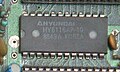 Hyundai RAM HY6116AP-10
 -
 STM32 SEM HD
 -
 STM32F103VGT6 SRAM
 -
 SRAM Cell (6 Transistors)
 -
 SRAM Cell (4 Transistors)


.svg)
.svg)
Ad. Transform your health with W8MD Weight Loss, Sleep & MedSpa

Tired of being overweight?
Special offer:
Budget GLP-1 weight loss medications
- Semaglutide starting from $29.99/week and up with insurance for visit of $59.99 and up per week self pay.
- Tirzepatide starting from $45.00/week and up (dose dependent) or $69.99/week and up self pay
✔ Same-week appointments, evenings & weekends
Learn more:
- GLP-1 weight loss clinic NYC
- W8MD's NYC medical weight loss
- W8MD Philadelphia GLP-1 shots
- Philadelphia GLP-1 injections
- Affordable GLP-1 shots NYC
|
WikiMD Medical Encyclopedia |
Medical Disclaimer: WikiMD is for informational purposes only and is not a substitute for professional medical advice. Content may be inaccurate or outdated and should not be used for diagnosis or treatment. Always consult your healthcare provider for medical decisions. Verify information with trusted sources such as CDC.gov and NIH.gov. By using this site, you agree that WikiMD is not liable for any outcomes related to its content. See full disclaimer.
Credits:Most images are courtesy of Wikimedia commons, and templates, categories Wikipedia, licensed under CC BY SA or similar.
Translate this page: - East Asian
中文,
日本,
한국어,
South Asian
हिन्दी,
தமிழ்,
తెలుగు,
Urdu,
ಕನ್ನಡ,
Southeast Asian
Indonesian,
Vietnamese,
Thai,
မြန်မာဘာသာ,
বাংলা
European
español,
Deutsch,
français,
Greek,
português do Brasil,
polski,
română,
русский,
Nederlands,
norsk,
svenska,
suomi,
Italian
Middle Eastern & African
عربى,
Turkish,
Persian,
Hebrew,
Afrikaans,
isiZulu,
Kiswahili,
Other
Bulgarian,
Hungarian,
Czech,
Swedish,
മലയാളം,
मराठी,
ਪੰਜਾਬੀ,
ગુજરાતી,
Portuguese,
Ukrainian
