Demjanov rearrangement
Demjanov Rearrangement is a significant chemical reaction that involves the transformation of primary amines into alcohols through the intermediacy of nitrous acid. This reaction is named after the Russian chemist Nikolai Jakovlevich Demjanov, who first reported it in the early 20th century. The Demjanov rearrangement is notable for its application in the synthesis of alcohols from amines, which are themselves readily obtainable from aldehydes and ketones. This reaction is particularly useful in organic synthesis and has been employed in the preparation of various complex molecules.
Mechanism[edit]
The Demjanov rearrangement begins with the conversion of a primary amine to a nitroso compound through treatment with nitrous acid, which is typically generated in situ from sodium nitrite and a mineral acid. The nitroso compound then undergoes tautomerization to form a hydroxylamine, which, upon further reaction with nitrous acid, generates a diazonium ion. This highly reactive species then undergoes a 1,2-rearrangement, where the alkyl group migrates to the neighboring nitrogen atom, resulting in the formation of an alcohol after hydrolysis.
Variants[edit]
A notable variant of the Demjanov rearrangement is the Tiffeneau-Demjanov rearrangement, which involves the ring expansion of cyclic amines to form larger ring systems. This variant is particularly useful for the synthesis of cyclic compounds with one additional ring member.
Applications[edit]
The Demjanov rearrangement has found applications in the synthesis of complex natural products and pharmaceuticals. Its ability to efficiently convert amines into alcohols makes it a valuable tool in the arsenal of organic chemists. The reaction has been utilized in the synthesis of various compounds, including steroids, alkaloids, and terpenes.
Limitations[edit]
Despite its utility, the Demjanov rearrangement has some limitations. The reaction conditions can sometimes lead to side reactions, including the over-oxidation of the product alcohol to a carbonyl compound. Additionally, the reaction's applicability is somewhat limited by the stability of the starting amine and the generated diazonium ion.
See Also[edit]
References[edit]
<references/>

-
 Demjanov rearrangement scheme
 -
 Mechanism of Demjanov rearrangement
 -
 SN2 mechanism in Demjanov rearrangement
 -
 Fattori exo product in Demjanov rearrangement
 -
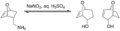 Fattori endo product in Demjanov rearrangement


Ad. Transform your health with W8MD Weight Loss, Sleep & MedSpa

Tired of being overweight?
Special offer:
Budget GLP-1 weight loss medications
- Semaglutide starting from $29.99/week and up with insurance for visit of $59.99 and up per week self pay.
- Tirzepatide starting from $45.00/week and up (dose dependent) or $69.99/week and up self pay
✔ Same-week appointments, evenings & weekends
Learn more:
- GLP-1 weight loss clinic NYC
- W8MD's NYC medical weight loss
- W8MD Philadelphia GLP-1 shots
- Philadelphia GLP-1 injections
- Affordable GLP-1 shots NYC
|
WikiMD Medical Encyclopedia |
Medical Disclaimer: WikiMD is for informational purposes only and is not a substitute for professional medical advice. Content may be inaccurate or outdated and should not be used for diagnosis or treatment. Always consult your healthcare provider for medical decisions. Verify information with trusted sources such as CDC.gov and NIH.gov. By using this site, you agree that WikiMD is not liable for any outcomes related to its content. See full disclaimer.
Credits:Most images are courtesy of Wikimedia commons, and templates, categories Wikipedia, licensed under CC BY SA or similar.
Translate this page: - East Asian
中文,
日本,
한국어,
South Asian
हिन्दी,
தமிழ்,
తెలుగు,
Urdu,
ಕನ್ನಡ,
Southeast Asian
Indonesian,
Vietnamese,
Thai,
မြန်မာဘာသာ,
বাংলা
European
español,
Deutsch,
français,
Greek,
português do Brasil,
polski,
română,
русский,
Nederlands,
norsk,
svenska,
suomi,
Italian
Middle Eastern & African
عربى,
Turkish,
Persian,
Hebrew,
Afrikaans,
isiZulu,
Kiswahili,
Other
Bulgarian,
Hungarian,
Czech,
Swedish,
മലയാളം,
मराठी,
ਪੰਜਾਬੀ,
ગુજરાતી,
Portuguese,
Ukrainian
