Velocity
Velocity[edit]

Velocity is a vector quantity that refers to "the rate at which an object changes its position." It is a fundamental concept in physics and is essential in the study of kinematics. Unlike speed, which is a scalar quantity, velocity includes both the magnitude and the direction of motion.
Definition[edit]
Velocity is defined as the rate of change of displacement with respect to time. Mathematically, it is expressed as:
- \( \mathbf{v} = \frac{d\mathbf{s}}{dt} \)
where \( \mathbf{v} \) is the velocity, \( \mathbf{s} \) is the displacement, and \( t \) is time.
Types of Velocity[edit]
Constant Velocity[edit]
When an object moves with constant velocity, it covers equal displacements in equal intervals of time, regardless of how small these intervals may be. This implies that both the speed and direction of the object remain unchanged.
Variable Velocity[edit]
Variable velocity occurs when either the speed or the direction of the object changes. This can be further classified into:
- Uniformly Accelerated Motion: When the velocity of an object changes at a constant rate.
- Non-uniformly Accelerated Motion: When the velocity changes at a variable rate.
Velocity vs. Speed[edit]

While speed is a scalar quantity that only considers the magnitude of motion, velocity is a vector quantity that considers both magnitude and direction. For example, if a car travels at 60 km/h to the north, its speed is 60 km/h, but its velocity is 60 km/h north.
Mathematical Representation[edit]
Velocity can be represented graphically using a velocity-time graph. The slope of a velocity-time graph represents the acceleration of the object.
Applications[edit]
Velocity is crucial in various fields such as engineering, astronomy, and sports. In engineering, it helps in designing vehicles and predicting their performance. In astronomy, it is used to calculate the orbits of celestial bodies.
Related Concepts[edit]

See Also[edit]
References[edit]
- Halliday, D., Resnick, R., & Walker, J. (2013). Fundamentals of Physics. Wiley.
- Serway, R. A., & Jewett, J. W. (2018). Physics for Scientists and Engineers. Cengage Learning.
Related Pages[edit]


-
 U.S. Navy sponsored Chevy Monte Carlo NASCAR at California Speedway
 -
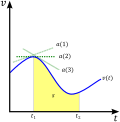 Velocity vs Time Graph
 -
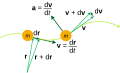 Kinematics Diagram
 -
 Radial and Tangential Components
Ad. Transform your health with W8MD Weight Loss, Sleep & MedSpa

Tired of being overweight?
Special offer:
Budget GLP-1 weight loss medications
- Semaglutide starting from $29.99/week and up with insurance for visit of $59.99 and up per week self pay.
- Tirzepatide starting from $45.00/week and up (dose dependent) or $69.99/week and up self pay
✔ Same-week appointments, evenings & weekends
Learn more:
- GLP-1 weight loss clinic NYC
- W8MD's NYC medical weight loss
- W8MD Philadelphia GLP-1 shots
- Philadelphia GLP-1 injections
- Affordable GLP-1 shots NYC
|
WikiMD Medical Encyclopedia |
Medical Disclaimer: WikiMD is for informational purposes only and is not a substitute for professional medical advice. Content may be inaccurate or outdated and should not be used for diagnosis or treatment. Always consult your healthcare provider for medical decisions. Verify information with trusted sources such as CDC.gov and NIH.gov. By using this site, you agree that WikiMD is not liable for any outcomes related to its content. See full disclaimer.
Credits:Most images are courtesy of Wikimedia commons, and templates, categories Wikipedia, licensed under CC BY SA or similar.
Translate this page: - East Asian
中文,
日本,
한국어,
South Asian
हिन्दी,
தமிழ்,
తెలుగు,
Urdu,
ಕನ್ನಡ,
Southeast Asian
Indonesian,
Vietnamese,
Thai,
မြန်မာဘာသာ,
বাংলা
European
español,
Deutsch,
français,
Greek,
português do Brasil,
polski,
română,
русский,
Nederlands,
norsk,
svenska,
suomi,
Italian
Middle Eastern & African
عربى,
Turkish,
Persian,
Hebrew,
Afrikaans,
isiZulu,
Kiswahili,
Other
Bulgarian,
Hungarian,
Czech,
Swedish,
മലയാളം,
मराठी,
ਪੰਜਾਬੀ,
ગુજરાતી,
Portuguese,
Ukrainian
