Adenylosuccinate lyase
Adenylosuccinate lyase[edit]

Adenylosuccinate lyase (ASL) is an enzyme that plays a crucial role in the purine biosynthesis pathway. It catalyzes two distinct reactions in the de novo synthesis of purine nucleotides, which are essential for the production of adenosine triphosphate (ATP), guanosine triphosphate (GTP), and other important biomolecules.
Function[edit]
Adenylosuccinate lyase is responsible for two key reactions in purine metabolism:
1. The conversion of adenylosuccinate to adenosine monophosphate (AMP) and fumarate. 2. The conversion of 5-aminoimidazole-4-(N-succinylcarboxamide) ribonucleotide (SAICAR) to 5-aminoimidazole-4-carboxamide ribonucleotide (AICAR) and fumarate.
These reactions are part of the purine nucleotide cycle, which is essential for the synthesis of purine nucleotides and the regulation of energy metabolism in cells.
Structure[edit]
Adenylosuccinate lyase is a homotetrameric enzyme, meaning it is composed of four identical subunits. Each subunit contains an active site where the substrate binds and the reaction takes place. The enzyme's structure allows it to facilitate the cleavage of the carbon-nitrogen bond in its substrates, leading to the formation of AMP and fumarate or AICAR and fumarate.
Mechanism[edit]

The reaction mechanism of adenylosuccinate lyase involves the formation of a covalent intermediate between the enzyme and the substrate. This intermediate is then cleaved to release the products. The enzyme utilizes a general acid-base catalysis mechanism, where specific amino acid residues in the active site act as proton donors and acceptors to facilitate the reaction.
Clinical significance[edit]
Deficiencies in adenylosuccinate lyase activity can lead to a rare metabolic disorder known as adenylosuccinate lyase deficiency. This condition is characterized by the accumulation of adenylosuccinate and SAICAR in tissues and bodily fluids, leading to a range of symptoms including developmental delay, seizures, and autistic features. The disorder is inherited in an autosomal recessive manner.
Related pages[edit]
Gallery[edit]
-
 Purine biosynthesis pathway
 -
 Overall reactions catalyzed by adenylosuccinate lyase


-
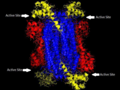 Active sites of adenylosuccinate lyase
 -
Purine biosynthesis pathway
-
Overall reactions catalyzed by adenylosuccinate lyase
-
 Reaction mechanism of adenylosuccinate lyase
Ad. Transform your life with W8MD's
GLP-1 weight loss injections special from $29.99 with insurance
|
WikiMD Medical Encyclopedia |
Medical Disclaimer: WikiMD is for informational purposes only and is not a substitute for professional medical advice. Content may be inaccurate or outdated and should not be used for diagnosis or treatment. Always consult your healthcare provider for medical decisions. Verify information with trusted sources such as CDC.gov and NIH.gov. By using this site, you agree that WikiMD is not liable for any outcomes related to its content. See full disclaimer.
Credits:Most images are courtesy of Wikimedia commons, and templates, categories Wikipedia, licensed under CC BY SA or similar.
Translate this page: - East Asian
中文,
日本,
한국어,
South Asian
हिन्दी,
தமிழ்,
తెలుగు,
Urdu,
ಕನ್ನಡ,
Southeast Asian
Indonesian,
Vietnamese,
Thai,
မြန်မာဘာသာ,
বাংলা
European
español,
Deutsch,
français,
Greek,
português do Brasil,
polski,
română,
русский,
Nederlands,
norsk,
svenska,
suomi,
Italian
Middle Eastern & African
عربى,
Turkish,
Persian,
Hebrew,
Afrikaans,
isiZulu,
Kiswahili,
Other
Bulgarian,
Hungarian,
Czech,
Swedish,
മലയാളം,
मराठी,
ਪੰਜਾਬੀ,
ગુજરાતી,
Portuguese,
Ukrainian
