Ground glass hepatocyte
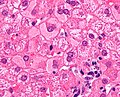
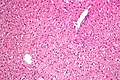
Ground glass hepatocyte refers to a distinctive histopathological finding characterized by hepatocytes displaying a finely granular, eosinophilic cytoplasm with a ground-glass appearance under light microscopy. This appearance is due to the accumulation of various substances within the hepatocyte, most commonly hepatitis B surface antigen (HBsAg) in cases of chronic Hepatitis B infection. Ground glass hepatocytes are considered a hallmark of certain liver diseases and are of particular interest in the diagnosis and management of Hepatitis B-related liver pathology.
Etiology[edit]
Ground glass hepatocytes are primarily associated with chronic Hepatitis B infection, where the accumulation of HBsAg within the endoplasmic reticulum of the hepatocyte leads to the characteristic ground glass appearance. However, similar morphological changes can be observed in other conditions, including Hepatitis C infection, drug-induced liver injury, and inherited metabolic disorders, although these are less common.
Pathogenesis[edit]
The ground glass appearance is the result of excessive accumulation of proteins within the hepatocyte's endoplasmic reticulum. In the context of Hepatitis B, the hepatitis B virus (HBV) directs the cell's machinery to produce large amounts of HBsAg, which aggregates within the endoplasmic reticulum, leading to its distension and the characteristic appearance. This accumulation can interfere with normal cell function and contribute to liver injury and inflammation.
Clinical Significance[edit]
The identification of ground glass hepatocytes is significant in the diagnosis and monitoring of liver diseases, particularly chronic Hepatitis B. Their presence can indicate active viral replication and liver damage. Additionally, the extent and distribution of ground glass hepatocytes can provide insights into the severity and progression of liver disease.
Diagnosis[edit]
Diagnosis of conditions associated with ground glass hepatocytes typically involves a combination of clinical evaluation, serological markers for hepatitis viruses, and liver biopsy. Histological examination of liver biopsy samples using light microscopy is crucial for identifying ground glass hepatocytes and assessing liver pathology.
Treatment and Prognosis[edit]
Treatment of conditions associated with ground glass hepatocytes focuses on the underlying cause. In the case of Hepatitis B, antiviral therapy aimed at reducing viral load and preventing liver damage is the mainstay of treatment. The prognosis depends on several factors, including the severity of liver disease, the efficacy of antiviral therapy, and the presence of complications such as cirrhosis or hepatocellular carcinoma.
See Also[edit]

-
 Ground glass hepatocyte
 -
 Ground glass hepatocyte
 -
 Ground glass hepatocyte
 -
 Ground glass hepatocyte


Ad. Transform your health with W8MD Weight Loss, Sleep & MedSpa

Tired of being overweight?
Special offer:
Budget GLP-1 weight loss medications
- Semaglutide starting from $29.99/week and up with insurance for visit of $59.99 and up per week self pay.
- Tirzepatide starting from $45.00/week and up (dose dependent) or $69.99/week and up self pay
✔ Same-week appointments, evenings & weekends
Learn more:
- GLP-1 weight loss clinic NYC
- W8MD's NYC medical weight loss
- W8MD Philadelphia GLP-1 shots
- Philadelphia GLP-1 injections
- Affordable GLP-1 shots NYC
|
WikiMD Medical Encyclopedia |
Medical Disclaimer: WikiMD is for informational purposes only and is not a substitute for professional medical advice. Content may be inaccurate or outdated and should not be used for diagnosis or treatment. Always consult your healthcare provider for medical decisions. Verify information with trusted sources such as CDC.gov and NIH.gov. By using this site, you agree that WikiMD is not liable for any outcomes related to its content. See full disclaimer.
Credits:Most images are courtesy of Wikimedia commons, and templates, categories Wikipedia, licensed under CC BY SA or similar.
Translate this page: - East Asian
中文,
日本,
한국어,
South Asian
हिन्दी,
தமிழ்,
తెలుగు,
Urdu,
ಕನ್ನಡ,
Southeast Asian
Indonesian,
Vietnamese,
Thai,
မြန်မာဘာသာ,
বাংলা
European
español,
Deutsch,
français,
Greek,
português do Brasil,
polski,
română,
русский,
Nederlands,
norsk,
svenska,
suomi,
Italian
Middle Eastern & African
عربى,
Turkish,
Persian,
Hebrew,
Afrikaans,
isiZulu,
Kiswahili,
Other
Bulgarian,
Hungarian,
Czech,
Swedish,
മലയാളം,
मराठी,
ਪੰਜਾਬੀ,
ગુજરાતી,
Portuguese,
Ukrainian
