Planck's law
Planck's Law[edit]
Planck's law, also known as Planck's radiation law, is a fundamental principle in physics that describes the spectral energy density of electromagnetic radiation emitted by a black body at a given temperature. It was formulated by the German physicist Max Planck in 1900 and played a crucial role in the development of quantum mechanics.
Background[edit]
Before the formulation of Planck's law, classical physics failed to explain certain phenomena related to the emission and absorption of electromagnetic radiation. According to classical theory, a black body should emit an infinite amount of energy at all wavelengths, which contradicted experimental observations. Planck's law provided a breakthrough by introducing the concept of quantization of energy.
Formulation[edit]
Planck's law states that the spectral energy density of radiation emitted by a black body at a given temperature is proportional to the frequency of the radiation and inversely proportional to the wavelength. Mathematically, it can be expressed as:
E(λ, T) = (2hc²/λ³) * (1/(e^(hc/λkT) - 1))
where: - E(λ, T) is the spectral energy density at wavelength λ and temperature T, - h is Planck's constant, - c is the speed of light, - k is the Boltzmann constant, and - e is the base of the natural logarithm.
Significance[edit]
Planck's law revolutionized our understanding of the behavior of electromagnetic radiation. It provided a theoretical explanation for the observed distribution of energy emitted by black bodies at different temperatures, known as the black body radiation spectrum. This spectrum follows a characteristic shape, with a peak intensity that shifts towards shorter wavelengths as the temperature increases.
Applications[edit]
Planck's law has numerous applications in various fields of science and technology. Some notable applications include:
1. Astrophysics: Planck's law is used to study the radiation emitted by stars and other celestial objects. By analyzing the spectral energy density, astronomers can determine the temperature and composition of these objects.
2. Thermodynamics: Planck's law is fundamental to the study of thermal radiation and plays a crucial role in understanding heat transfer and energy conversion processes.
3. Quantum mechanics: Planck's law was a key inspiration for the development of quantum mechanics. It introduced the concept of energy quantization, which laid the foundation for the wave-particle duality of light and matter.
See Also[edit]
- Black body radiation - Max Planck - Quantum mechanics
References[edit]
1. Planck, M. (1901). "Über das Gesetz der Energieverteilung im Normalspectrum." Annalen der Physik, 309(3), 553-563.
2. Kittel, C., & Kroemer, H. (1980). "Thermal Physics." W. H. Freeman and Company.
3. Griffiths, D. J. (2005). "Introduction to Quantum Mechanics." Pearson Education.
-
 Planck's law
 -
 Planck's law
 -
 Planck's law
 -
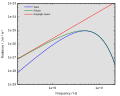 Planck's law
 -
 Planck's law


Ad. Transform your life with W8MD's
GLP-1 weight loss injections special from $29.99 with insurance
|
WikiMD Medical Encyclopedia |
Medical Disclaimer: WikiMD is for informational purposes only and is not a substitute for professional medical advice. Content may be inaccurate or outdated and should not be used for diagnosis or treatment. Always consult your healthcare provider for medical decisions. Verify information with trusted sources such as CDC.gov and NIH.gov. By using this site, you agree that WikiMD is not liable for any outcomes related to its content. See full disclaimer.
Credits:Most images are courtesy of Wikimedia commons, and templates, categories Wikipedia, licensed under CC BY SA or similar.
Translate this page: - East Asian
中文,
日本,
한국어,
South Asian
हिन्दी,
தமிழ்,
తెలుగు,
Urdu,
ಕನ್ನಡ,
Southeast Asian
Indonesian,
Vietnamese,
Thai,
မြန်မာဘာသာ,
বাংলা
European
español,
Deutsch,
français,
Greek,
português do Brasil,
polski,
română,
русский,
Nederlands,
norsk,
svenska,
suomi,
Italian
Middle Eastern & African
عربى,
Turkish,
Persian,
Hebrew,
Afrikaans,
isiZulu,
Kiswahili,
Other
Bulgarian,
Hungarian,
Czech,
Swedish,
മലയാളം,
मराठी,
ਪੰਜਾਬੀ,
ગુજરાતી,
Portuguese,
Ukrainian
