Otic ganglion
Otic Ganglion
The Otic ganglion is a small parasympathetic ganglion located immediately below the foramen ovale in the infratemporal fossa and on the medial surface of the mandibular nerve. It is functionally associated with the glossopharyngeal nerve and innervates the parotid gland for salivation.
Anatomy[edit]
The Otic ganglion is one of four parasympathetic ganglia of the head and neck. It is the smallest of the four and is located in the infratemporal fossa, immediately below the foramen ovale. The ganglion is positioned directly on the medial surface of the mandibular nerve (the V3 branch of the trigeminal nerve) and is connected to it by two small branches.
Function[edit]
The otic ganglion is functionally associated with the glossopharyngeal nerve. It receives preganglionic parasympathetic fibers from the glossopharyngeal nerve via the lesser petrosal nerve. These fibers synapse in the ganglion with postganglionic fibers that pass through the auriculotemporal nerve to reach the parotid gland, where they stimulate salivation.
Clinical significance[edit]
Damage to the otic ganglion can result in a loss of parasympathetic supply to the parotid gland. This can lead to a decrease in salivation, resulting in a dry mouth condition known as xerostomia.
See also[edit]
References[edit]
<references />

-
 Otic ganglion and its connections
 -
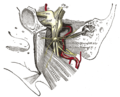 Otic ganglion, mandibular nerve, and branches
 -
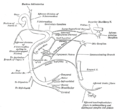 Otic ganglion and associated nerves
 -
 Otic ganglion and its anatomical relations


Ad. Transform your health with W8MD Weight Loss, Sleep & MedSpa

Tired of being overweight?
Get started with evidence based, physician-supervised
affordable GLP-1 weight loss injections
Now available in New York City and Philadelphia:
- Semaglutide starting from $59.99/week and up
- Tirzepatide starting from $69.99/week and up (dose dependent)
✔ Evidence-based medical weight loss ✔ Insurance-friendly visits available ✔ Same-week appointments, evenings & weekends
Learn more:
Start your transformation today with W8MD weight loss centers.
|
WikiMD Medical Encyclopedia |
Medical Disclaimer: WikiMD is for informational purposes only and is not a substitute for professional medical advice. Content may be inaccurate or outdated and should not be used for diagnosis or treatment. Always consult your healthcare provider for medical decisions. Verify information with trusted sources such as CDC.gov and NIH.gov. By using this site, you agree that WikiMD is not liable for any outcomes related to its content. See full disclaimer.
Credits:Most images are courtesy of Wikimedia commons, and templates, categories Wikipedia, licensed under CC BY SA or similar.
Translate this page: - East Asian
中文,
日本,
한국어,
South Asian
हिन्दी,
தமிழ்,
తెలుగు,
Urdu,
ಕನ್ನಡ,
Southeast Asian
Indonesian,
Vietnamese,
Thai,
မြန်မာဘာသာ,
বাংলা
European
español,
Deutsch,
français,
Greek,
português do Brasil,
polski,
română,
русский,
Nederlands,
norsk,
svenska,
suomi,
Italian
Middle Eastern & African
عربى,
Turkish,
Persian,
Hebrew,
Afrikaans,
isiZulu,
Kiswahili,
Other
Bulgarian,
Hungarian,
Czech,
Swedish,
മലയാളം,
मराठी,
ਪੰਜਾਬੀ,
ગુજરાતી,
Portuguese,
Ukrainian
