Common hepatic artery
Common Hepatic Artery
The common hepatic artery is a vital artery in the human body that originates from the celiac trunk, a major branch of the abdominal aorta. It is an essential component of the arterial supply to the liver, stomach, duodenum, and pancreas, playing a crucial role in delivering oxygenated blood to these organs.
Anatomy[edit]
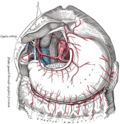
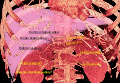
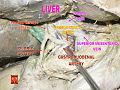
The common hepatic artery typically arises from the celiac trunk, which is the first major branch of the abdominal aorta. After its origin, it travels towards the liver, where it divides into two main branches: the proper hepatic artery and the gastroduodenal artery. The proper hepatic artery further divides into the right and left hepatic arteries to supply the liver, while the gastroduodenal artery supplies blood to the stomach and duodenum.
Branches[edit]
- Proper Hepatic Artery: Continues from the common hepatic artery to supply the liver.
- Gastroduodenal Artery: Supplies blood to the stomach and duodenum.
- Additional branches may include the cystic artery that supplies the gallbladder and the right gastric artery that contributes to the lesser curvature of the stomach.
Clinical Significance[edit]
The common hepatic artery is of paramount importance in surgical procedures involving the liver, gallbladder, and pancreas. Its anatomical variations and relationship with surrounding structures must be thoroughly understood to avoid intraoperative injuries. Conditions such as hepatic artery aneurysm or hepatic artery thrombosis can significantly impact liver function and require prompt medical intervention.
Variations[edit]
Anatomical variations of the common hepatic artery are common, with some individuals having an accessory hepatic artery that arises from the superior mesenteric artery or other nearby vessels. These variations are critical considerations during imaging evaluations and surgical procedures to prevent inadvertent damage.
Diagnosis and Imaging[edit]
Imaging techniques such as ultrasound, CT scan, and magnetic resonance imaging (MRI) are utilized to visualize the common hepatic artery and its branches. These modalities are essential in diagnosing conditions affecting the artery, planning surgical interventions, and monitoring postoperative outcomes.
Treatment[edit]
Treatment of conditions affecting the common hepatic artery depends on the underlying cause. Surgical intervention may be required to repair aneurysms or restore blood flow in cases of thrombosis. In some instances, minimally invasive procedures such as angioplasty and stenting may be employed.
See Also[edit]

-
 Common hepatic artery
 -
 Common hepatic artery
 -
 Common hepatic artery


Ad. Transform your life with W8MD's
GLP-1 weight loss injections special from $29.99 with insurance
|
WikiMD Medical Encyclopedia |
Medical Disclaimer: WikiMD is for informational purposes only and is not a substitute for professional medical advice. Content may be inaccurate or outdated and should not be used for diagnosis or treatment. Always consult your healthcare provider for medical decisions. Verify information with trusted sources such as CDC.gov and NIH.gov. By using this site, you agree that WikiMD is not liable for any outcomes related to its content. See full disclaimer.
Credits:Most images are courtesy of Wikimedia commons, and templates, categories Wikipedia, licensed under CC BY SA or similar.
Translate this page: - East Asian
中文,
日本,
한국어,
South Asian
हिन्दी,
தமிழ்,
తెలుగు,
Urdu,
ಕನ್ನಡ,
Southeast Asian
Indonesian,
Vietnamese,
Thai,
မြန်မာဘာသာ,
বাংলা
European
español,
Deutsch,
français,
Greek,
português do Brasil,
polski,
română,
русский,
Nederlands,
norsk,
svenska,
suomi,
Italian
Middle Eastern & African
عربى,
Turkish,
Persian,
Hebrew,
Afrikaans,
isiZulu,
Kiswahili,
Other
Bulgarian,
Hungarian,
Czech,
Swedish,
മലയാളം,
मराठी,
ਪੰਜਾਬੀ,
ગુજરાતી,
Portuguese,
Ukrainian
