Pleurotus ostreatus
Pleurotus ostreatus, commonly known as the oyster mushroom, is a species of fungus in the family Pleurotaceae. It is a saprotrophic fungus, meaning it feeds on dead and decaying organic matter, particularly hardwoods.
Taxonomy[edit]
The species was first described scientifically by Miles Joseph Berkeley in 1871. The genus name Pleurotus derives from the Greek words pleuron, meaning "side", and otus, meaning "ear". This refers to the mushroom's characteristic ear-like shape. The species name ostreatus refers to the oyster-like appearance of the mature fruiting bodies.
Description[edit]
The fruiting body of Pleurotus ostreatus is typically 5–25 cm in diameter and has a unique shape that resembles an oyster, hence the common name. The cap is smooth and often convex, with a white to gray color that darkens with age. The gills are white and descend on the short, stout stem. The spore print is lilac-gray.
Distribution and habitat[edit]
Pleurotus ostreatus is widely distributed across the globe, found in temperate and subtropical forests in North America, Europe, Asia, and Australia. It grows on dead and decaying wood, particularly hardwoods such as oak and beech.
Cultivation[edit]
Oyster mushrooms are one of the most widely cultivated mushrooms due to their fast growth, adaptability to various growth mediums, and culinary value. They can be grown on a variety of substrates, including straw, coffee grounds, and other agricultural waste products.
Culinary uses[edit]
The oyster mushroom is popular in cooking due to its versatile flavor, which is often described as mild with a slight hint of anise. It can be used in a variety of dishes, including stir-fries, soups, and pasta.
Medicinal uses[edit]
Pleurotus ostreatus has been used in traditional medicine for its purported health benefits. Modern research has suggested that it may have antimicrobial, anticancer, and cholesterol-lowering properties, although more research is needed to confirm these effects.
See also[edit]

-
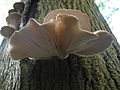 Pleurotus ostreatus growing on a tree
 -
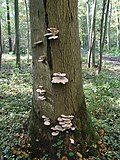 Close-up of Pleurotus ostreatus gills
 -
 Pleurotus ostreatus in Eglinton Park


Ad. Transform your health with W8MD Weight Loss, Sleep & MedSpa

Tired of being overweight?
Special offer:
Budget GLP-1 weight loss medications
- Semaglutide starting from $29.99/week and up with insurance for visit of $59.99 and up per week self pay.
- Tirzepatide starting from $45.00/week and up (dose dependent) or $69.99/week and up self pay
✔ Same-week appointments, evenings & weekends
Learn more:
- GLP-1 weight loss clinic NYC
- W8MD's NYC medical weight loss
- W8MD Philadelphia GLP-1 shots
- Philadelphia GLP-1 injections
- Affordable GLP-1 shots NYC
|
WikiMD Medical Encyclopedia |
Medical Disclaimer: WikiMD is for informational purposes only and is not a substitute for professional medical advice. Content may be inaccurate or outdated and should not be used for diagnosis or treatment. Always consult your healthcare provider for medical decisions. Verify information with trusted sources such as CDC.gov and NIH.gov. By using this site, you agree that WikiMD is not liable for any outcomes related to its content. See full disclaimer.
Credits:Most images are courtesy of Wikimedia commons, and templates, categories Wikipedia, licensed under CC BY SA or similar.
Translate this page: - East Asian
中文,
日本,
한국어,
South Asian
हिन्दी,
தமிழ்,
తెలుగు,
Urdu,
ಕನ್ನಡ,
Southeast Asian
Indonesian,
Vietnamese,
Thai,
မြန်မာဘာသာ,
বাংলা
European
español,
Deutsch,
français,
Greek,
português do Brasil,
polski,
română,
русский,
Nederlands,
norsk,
svenska,
suomi,
Italian
Middle Eastern & African
عربى,
Turkish,
Persian,
Hebrew,
Afrikaans,
isiZulu,
Kiswahili,
Other
Bulgarian,
Hungarian,
Czech,
Swedish,
മലയാളം,
मराठी,
ਪੰਜਾਬੀ,
ગુજરાતી,
Portuguese,
Ukrainian
