Diner lingo
Diner lingo is a form of American English slang used by waitstaff and cooks in diners and restaurants. It is characterized by its unique terms, phrases, and abbreviations, many of which originated in the early 20th century. Diner lingo was developed as a means of efficient and entertaining communication between kitchen staff and servers in the noisy, fast-paced diner environment. This article explores the origins, examples, and the decline of diner lingo in contemporary dining culture.
Origins[edit]
Diner lingo emerged in the United States during the early 1900s, a time when diners and small, fast-service restaurants began to proliferate across the country. These establishments, often open 24 hours, required a quick and efficient means of communication between the waitstaff and the cooks. Diner lingo evolved as a shorthand to quickly convey orders, with the added benefit of amusing customers and creating a unique dining experience.
Examples[edit]
Diner lingo includes a wide variety of terms, some of which are still recognized today, while others have fallen out of use. Here are a few examples:
- Adam and Eve on a raft – Two poached eggs on toast.
- Burn one, take it through the garden and pin a rose on it – A hamburger with lettuce, tomato, and onion.
- Cowboy with spurs – A western omelette with French fries.
- Shingle with a shimmy and a shake – Buttered toast with jelly or jam.
- Two cows, make them cry – Two hamburgers with onions.
- Wreck 'em – Scrambled eggs.
Decline[edit]
The use of diner lingo has declined significantly since its mid-20th century heyday. Factors contributing to this decline include the standardization of restaurant operations, the advent of computerized ordering systems, and changes in diner culture. While some terms are still used in certain establishments, much of the original lingo has been lost or is used more for novelty than necessity.
Contemporary Use[edit]
Today, diner lingo is often encountered in a historical or nostalgic context. Some diners, particularly those that aim to recreate a mid-20th century atmosphere, continue to use and celebrate diner lingo as part of the dining experience. It is also a subject of interest among linguists and cultural historians who study the evolution of language and slang in American culture.
Conclusion[edit]
Diner lingo serves as a fascinating example of occupational slang, reflecting the creativity, humor, and efficiency of diner staff throughout the 20th century. While its practical use has diminished, the charm and wit of diner lingo continue to captivate those interested in American diner culture and the evolution of language.
This article is a linguistics stub. You can help WikiMD by expanding it!
-
 Salem Diner in Salem, Massachusetts
 -
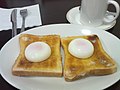 Two poached eggs on toast
 -
 Corned beef hash


Ad. Transform your life with W8MD's Budget GLP-1 injections from $29.99


W8MD offers medical weight loss programs including NYC medical weight loss and Philadelphia medical weight loss offering:
- Affordable GLP1 shots (generic and brand names) such as
- Wegovy NYC (Semaglutide)
- Zepbound NYC /
- Learn more: Budget GLP1 weight loss injections NYC & Philadelphia GLP1 weight loss shots
- Most insurances accepted
- Lowest cost GLP1 weight loss NYC such as Semaglutide starting from $29.99/week and $45.00/week (Tirzepatide) with insurance.
- Prescription weight loss NYC including:
NYC weight loss doctor appointmentsNYC weight loss doctor appointments
Start your physician weight loss journey today at our:
- NYC medical weight loss
- Philadelphia medical weight loss
- Call 718-946-5500 for NYC or 215-676-2334 for Philadelphia
Tags: Budget glp1 weight loss NYC, Zepbound NYC, Philadelphia medical weight loss, Wegovy NYC, Affordable glp1 shots Philadelphia


|
WikiMD's Wellness Encyclopedia |
| Let Food Be Thy Medicine Medicine Thy Food - Hippocrates |
Medical Disclaimer: WikiMD is not a substitute for professional medical advice. The information on WikiMD is provided as an information resource only, may be incorrect, outdated or misleading, and is not to be used or relied on for any diagnostic or treatment purposes. Please consult your health care provider before making any healthcare decisions or for guidance about a specific medical condition. WikiMD expressly disclaims responsibility, and shall have no liability, for any damages, loss, injury, or liability whatsoever suffered as a result of your reliance on the information contained in this site. By visiting this site you agree to the foregoing terms and conditions, which may from time to time be changed or supplemented by WikiMD. If you do not agree to the foregoing terms and conditions, you should not enter or use this site. See full disclaimer.
Credits:Most images are courtesy of Wikimedia commons, and templates, categories Wikipedia, licensed under CC BY SA or similar.
Translate this page: - East Asian
中文,
日本,
한국어,
South Asian
हिन्दी,
தமிழ்,
తెలుగు,
Urdu,
ಕನ್ನಡ,
Southeast Asian
Indonesian,
Vietnamese,
Thai,
မြန်မာဘာသာ,
বাংলা
European
español,
Deutsch,
français,
Greek,
português do Brasil,
polski,
română,
русский,
Nederlands,
norsk,
svenska,
suomi,
Italian
Middle Eastern & African
عربى,
Turkish,
Persian,
Hebrew,
Afrikaans,
isiZulu,
Kiswahili,
Other
Bulgarian,
Hungarian,
Czech,
Swedish,
മലയാളം,
मराठी,
ਪੰਜਾਬੀ,
ગુજરાતી,
Portuguese,
Ukrainian

