Boltzmann distribution
Boltzmann distribution describes the distribution of particles over various energy states in a system in thermal equilibrium at a definite temperature. It is a cornerstone concept in statistical mechanics, named after the Austrian physicist Ludwig Boltzmann, who made significant contributions to the field of thermodynamics and statistical mechanics.
Overview[edit]
The Boltzmann distribution provides a probability distribution that predicts the number of particles (such as atoms or molecules) expected to be found in each of the available energy states. This distribution is crucial for understanding the behavior of systems in equilibrium at the microscopic level. It applies to various scenarios, including gases, solids, and even the distribution of stars in a galaxy, provided the system is in thermal equilibrium.
Mathematical Formulation[edit]
The probability P of finding a particle in a state with energy E is given by the Boltzmann distribution formula:
\[ P(E) = \frac{g(E) e^{-\frac{E}{kT}}}{Z} \]
where:
- g(E) is the degeneracy of the state with energy E, indicating the number of states that have the same energy level.
- e is the base of the natural logarithm.
- E is the energy of the state.
- k is the Boltzmann constant, which relates the average kinetic energy of particles in a gas with the temperature of the gas.
- T is the absolute temperature of the system.
- Z is the partition function, a normalization factor ensuring that the sum of probabilities over all states equals one. It is given by:
\[ Z = \sum_{i} g(E_i) e^{-\frac{E_i}{kT}} \]
Applications[edit]
The Boltzmann distribution has wide-ranging applications across physics and chemistry. It is fundamental in explaining phenomena such as the distribution of molecular speeds in gases (described by the Maxwell-Boltzmann distribution), the population of excited states in atoms and molecules, chemical equilibrium, and the behavior of electrons in conductors at different temperatures.
Derivation[edit]
The Boltzmann distribution can be derived using the principles of statistical mechanics, specifically by maximizing the entropy of a system subject to the constraint of a fixed total energy. This approach leads to the realization that the most probable distribution of particles among available energy states, for a system in thermal equilibrium, follows the Boltzmann distribution.
Limitations[edit]
While the Boltzmann distribution is widely applicable, it has limitations. It assumes that the particles do not interact, except for brief collisions. This assumption may not hold in systems with strong inter-particle forces, such as in condensed matter physics. Additionally, the Boltzmann distribution applies to classical systems, and quantum effects are not accounted for, although similar distributions exist for quantum systems (e.g., the Fermi-Dirac distribution and the Bose-Einstein distribution).
See Also[edit]
- Statistical mechanics
- Thermodynamics
- Maxwell-Boltzmann distribution
- Fermi-Dirac distribution
- Bose-Einstein distribution
References[edit]
<references/>
 | This physics-related article is a stub. You can help WikiMD by expanding the page. |
-
 Exponential probability density function
 -
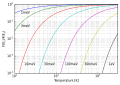 Boltzmann distribution graph


Medical Disclaimer: WikiMD is for informational purposes only and is not a substitute for professional medical advice. Content may be inaccurate or outdated and should not be used for diagnosis or treatment. Always consult your healthcare provider for medical decisions. Verify information with trusted sources such as CDC.gov and NIH.gov. By using this site, you agree that WikiMD is not liable for any outcomes related to its content. See full disclaimer.
Credits:Most images are courtesy of Wikimedia commons, and templates, categories Wikipedia, licensed under CC BY SA or similar.
Translate this page: - East Asian
中文,
日本,
한국어,
South Asian
हिन्दी,
தமிழ்,
తెలుగు,
Urdu,
ಕನ್ನಡ,
Southeast Asian
Indonesian,
Vietnamese,
Thai,
မြန်မာဘာသာ,
বাংলা
European
español,
Deutsch,
français,
Greek,
português do Brasil,
polski,
română,
русский,
Nederlands,
norsk,
svenska,
suomi,
Italian
Middle Eastern & African
عربى,
Turkish,
Persian,
Hebrew,
Afrikaans,
isiZulu,
Kiswahili,
Other
Bulgarian,
Hungarian,
Czech,
Swedish,
മലയാളം,
मराठी,
ਪੰਜਾਬੀ,
ગુજરાતી,
Portuguese,
Ukrainian
