Preformationism
Preformationism[edit]
Preformationism is a theory in developmental biology that suggests that all organisms exist in a miniature, preformed state within either the egg or the sperm. According to this theory, the development of an organism is simply the growth and enlargement of these preexisting structures. Preformationism was a prominent theory in the 17th and 18th centuries, but it has since been largely discredited in favor of the theory of epigenesis.
History[edit]
The concept of preformationism can be traced back to ancient Greek and Roman philosophers who believed in the existence of homunculi, tiny fully-formed individuals within the sperm. However, it was not until the 17th century that preformationism gained significant attention.
One of the key figures in the development of preformationism was Antonie van Leeuwenhoek, a Dutch scientist who made significant advancements in microscopy. His observations of sperm cells led him to propose that they contained fully-formed individuals, which he called "animalcules."
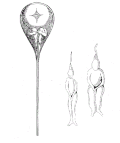
Another influential proponent of preformationism was Nicolas Hartsoeker, a Dutch mathematician and microscopist. Hartsoeker's drawings of sperm cells, which appeared to show miniature humans, further popularized the theory.
Preformationism reached its peak in the 18th century, with many prominent scientists and philosophers supporting the idea. However, as microscopy techniques improved and more detailed observations were made, doubts began to arise.
Criticisms and Decline[edit]
One of the main criticisms of preformationism was the lack of evidence for the existence of preformed individuals within the egg or sperm. As microscopy techniques improved, scientists were able to observe the development of embryos in more detail, and it became clear that organisms do not exist in a fully-formed state prior to development.
The theory of epigenesis, which proposes that organisms develop from undifferentiated cells through a process of gradual differentiation, gained popularity as an alternative to preformationism. Epigenesis was supported by the work of scientists such as Caspar Friedrich Wolff, who observed the development of chick embryos and proposed that organs and tissues form progressively over time.
By the 19th century, preformationism had largely fallen out of favor among the scientific community. The discovery of the cell and the understanding of genetics further undermined the theory, as it became clear that development involves complex interactions between genes and the environment.
Legacy[edit]
Although preformationism is no longer considered a valid scientific theory, its influence can still be seen in certain areas. The idea of preformationism had a significant impact on the field of embryology, as it sparked debates and discussions that ultimately led to a better understanding of development.
Furthermore, preformationism played a role in shaping philosophical and religious beliefs about the nature of life and reproduction. The concept of preformed individuals within the egg or sperm raised questions about the origins of life and the existence of a preexisting blueprint for each organism.
See Also[edit]
References[edit]
<references />
Preformationism[edit]
-
 Preformationism
 -
 Preformationism

Ad. Transform your health with W8MD Weight Loss, Sleep & MedSpa

Tired of being overweight?
Special offer:
Budget GLP-1 weight loss medications
- Semaglutide starting from $29.99/week and up with insurance for visit of $59.99 and up per week self pay.
- Tirzepatide starting from $45.00/week and up (dose dependent) or $69.99/week and up self pay
✔ Same-week appointments, evenings & weekends
Learn more:
- GLP-1 weight loss clinic NYC
- W8MD's NYC medical weight loss
- W8MD Philadelphia GLP-1 shots
- Philadelphia GLP-1 injections
- Affordable GLP-1 shots NYC
- Budget GLP-1 shots
|
WikiMD Medical Encyclopedia |
Medical Disclaimer: WikiMD is for informational purposes only and is not a substitute for professional medical advice. Content may be inaccurate or outdated and should not be used for diagnosis or treatment. Always consult your healthcare provider for medical decisions. Verify information with trusted sources such as CDC.gov and NIH.gov. By using this site, you agree that WikiMD is not liable for any outcomes related to its content. See full disclaimer.
Credits:Most images are courtesy of Wikimedia commons, and templates, categories Wikipedia, licensed under CC BY SA or similar.
Translate this page: - East Asian
中文,
日本,
한국어,
South Asian
हिन्दी,
தமிழ்,
తెలుగు,
Urdu,
ಕನ್ನಡ,
Southeast Asian
Indonesian,
Vietnamese,
Thai,
မြန်မာဘာသာ,
বাংলা
European
español,
Deutsch,
français,
Greek,
português do Brasil,
polski,
română,
русский,
Nederlands,
norsk,
svenska,
suomi,
Italian
Middle Eastern & African
عربى,
Turkish,
Persian,
Hebrew,
Afrikaans,
isiZulu,
Kiswahili,
Other
Bulgarian,
Hungarian,
Czech,
Swedish,
മലയാളം,
मराठी,
ਪੰਜਾਬੀ,
ગુજરાતી,
Portuguese,
Ukrainian
