Vacuum insulated evaporator
Vacuum Insulated Evaporator[edit]
A vacuum insulated evaporator (VIE) is a device used in industrial applications to store and vaporize cryogenic liquids such as liquid oxygen, nitrogen, or argon. These evaporators are essential in processes where gases are required in large quantities and at specific temperatures and pressures.

Design and Function[edit]
The primary function of a vacuum insulated evaporator is to convert cryogenic liquids into gases. This is achieved by utilizing the heat from the surrounding environment to vaporize the liquid stored within the insulated tank. The insulation minimizes heat loss, ensuring efficient vaporization.
A typical VIE consists of a double-walled tank, where the space between the walls is evacuated to create a vacuum. This vacuum acts as an insulator, significantly reducing heat transfer from the outside environment to the cryogenic liquid inside. The inner vessel is usually made of stainless steel to withstand the low temperatures and pressures involved.
Applications[edit]
Vacuum insulated evaporators are widely used in industries such as healthcare, metallurgy, and food processing. In healthcare, they provide a reliable source of medical gases like oxygen and nitrogen. In metallurgy, they are used to supply gases for processes such as welding and cutting. The food industry uses VIEs to preserve and transport perishable goods by maintaining low temperatures.
Advantages[edit]
The use of vacuum insulation in these evaporators offers several advantages:
- Efficiency: The vacuum insulation reduces heat ingress, minimizing the energy required for vaporization.
- Safety: The robust design and materials used ensure safe storage and handling of cryogenic liquids.
- Cost-effectiveness: By reducing heat loss, VIEs lower operational costs associated with maintaining cryogenic temperatures.
Maintenance and Safety[edit]
Regular maintenance of vacuum insulated evaporators is crucial to ensure their efficient and safe operation. This includes checking for leaks, inspecting the vacuum integrity, and ensuring that all safety valves and pressure relief devices are functioning correctly.
Safety measures include proper training for personnel handling cryogenic liquids and ensuring that all equipment is compliant with industry standards and regulations.

Related Pages[edit]
-
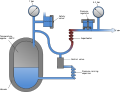 Diagram of a Vacuum Insulated Evaporator
 -
 Photo of a Vacuum Insulated Evaporator
Ad. Transform your life with W8MD's
GLP-1 weight loss injections special from $29.99 with insurance
|
WikiMD Medical Encyclopedia |
Medical Disclaimer: WikiMD is for informational purposes only and is not a substitute for professional medical advice. Content may be inaccurate or outdated and should not be used for diagnosis or treatment. Always consult your healthcare provider for medical decisions. Verify information with trusted sources such as CDC.gov and NIH.gov. By using this site, you agree that WikiMD is not liable for any outcomes related to its content. See full disclaimer.
Credits:Most images are courtesy of Wikimedia commons, and templates, categories Wikipedia, licensed under CC BY SA or similar.
Translate this page: - East Asian
中文,
日本,
한국어,
South Asian
हिन्दी,
தமிழ்,
తెలుగు,
Urdu,
ಕನ್ನಡ,
Southeast Asian
Indonesian,
Vietnamese,
Thai,
မြန်မာဘာသာ,
বাংলা
European
español,
Deutsch,
français,
Greek,
português do Brasil,
polski,
română,
русский,
Nederlands,
norsk,
svenska,
suomi,
Italian
Middle Eastern & African
عربى,
Turkish,
Persian,
Hebrew,
Afrikaans,
isiZulu,
Kiswahili,
Other
Bulgarian,
Hungarian,
Czech,
Swedish,
മലയാളം,
मराठी,
ਪੰਜਾਬੀ,
ગુજરાતી,
Portuguese,
Ukrainian
