Cashless society
Cashless Society refers to an economic state where financial transactions are not conducted with money in the form of physical banknotes or coins, but rather through the transfer of digital information (usually an electronic representation of money) between the parties involved. This concept has gained significant traction in the 21st century, driven by advancements in technology, the internet, and the widespread adoption of mobile payment systems.
Overview[edit]
In a cashless society, payments are made through digital channels such as credit and debit cards, electronic funds transfers, and mobile payment systems. These transactions are processed via secure, digital networks, and the records of these transactions are stored electronically. The move towards a cashless society is supported by governments and financial institutions as it can reduce the costs of printing and handling banknotes and coins, increase the efficiency of transactions, and reduce instances of tax evasion and illegal activities that rely on cash transactions.
Benefits[edit]
- Efficiency and Convenience: Digital transactions can be faster and more convenient than handling physical cash. They can be made 24/7, without the need for physical presence or the exchange of physical money.
- Security: Electronic payments can be more secure than cash, as they often require authentication. Additionally, if a card or digital wallet is lost or stolen, it can be blocked or secured, unlike cash.
- Traceability: Digital transactions leave a record, which can help in budgeting and spending analysis, as well as reducing crime and tax evasion associated with cash.
Challenges[edit]
- Privacy Concerns: Digital transactions can be tracked, raising concerns about privacy and the potential for surveillance by governments or corporations.
- Digital Divide: Not everyone has access to the digital tools required for cashless transactions, which can exclude parts of the population, particularly in less developed countries or among older and less tech-savvy individuals.
- Dependence on Technology: A cashless society relies heavily on technology, which can be vulnerable to outages, cyber-attacks, and technical failures.
Global Trends[edit]
Different countries are at various stages of moving towards a cashless society. Some nations, like Sweden, are leading the way, with cash transactions becoming increasingly rare. Others are gradually increasing the infrastructure and incentives for cashless payments. The trend is also influenced by cultural attitudes towards cash and technology, as well as the robustness of the financial and technological infrastructure.
Implications[edit]
The move towards a cashless society has broad implications, including changes in consumer behavior, the role of central banks, and the global financial system. It also raises questions about the future of privacy, the digital divide, and economic inequality, as those without access to digital payment systems could be further marginalized.
See Also[edit]
- Electronic Funds Transfer
- Mobile Payment
- Digital Currency
- Financial Technology
- Cybersecurity in Financial Transactions

Cashless_society[edit]
-
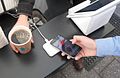 A person using a mobile device for payment, representing modern cashless transactions.
 -
 Historical image of "Koks Emil" in Berlin, illustrating early 20th-century street transactions.


Ad. Transform your health with W8MD Weight Loss, Sleep & MedSpa

Tired of being overweight?
Get started with evidence based, physician-supervised
affordable GLP-1 weight loss injections
Now available in New York City and Philadelphia:
- Semaglutide starting from $59.99/week and up
- Tirzepatide starting from $69.99/week and up (dose dependent)
✔ Evidence-based medical weight loss ✔ Insurance-friendly visits available ✔ Same-week appointments, evenings & weekends
Learn more:
Start your transformation today with W8MD weight loss centers.
|
WikiMD Medical Encyclopedia |
Medical Disclaimer: WikiMD is for informational purposes only and is not a substitute for professional medical advice. Content may be inaccurate or outdated and should not be used for diagnosis or treatment. Always consult your healthcare provider for medical decisions. Verify information with trusted sources such as CDC.gov and NIH.gov. By using this site, you agree that WikiMD is not liable for any outcomes related to its content. See full disclaimer.
Credits:Most images are courtesy of Wikimedia commons, and templates, categories Wikipedia, licensed under CC BY SA or similar.
Translate this page: - East Asian
中文,
日本,
한국어,
South Asian
हिन्दी,
தமிழ்,
తెలుగు,
Urdu,
ಕನ್ನಡ,
Southeast Asian
Indonesian,
Vietnamese,
Thai,
မြန်မာဘာသာ,
বাংলা
European
español,
Deutsch,
français,
Greek,
português do Brasil,
polski,
română,
русский,
Nederlands,
norsk,
svenska,
suomi,
Italian
Middle Eastern & African
عربى,
Turkish,
Persian,
Hebrew,
Afrikaans,
isiZulu,
Kiswahili,
Other
Bulgarian,
Hungarian,
Czech,
Swedish,
മലയാളം,
मराठी,
ਪੰਜਾਬੀ,
ગુજરાતી,
Portuguese,
Ukrainian
