Farinograph
Farinograph is a device used in the field of baking science and food technology to measure the rheological properties of flour. It is an essential tool for bakers, food scientists, and milling professionals to determine the suitability of a flour for a specific purpose.
History[edit]
The Farinograph was first developed in the early 20th century by the Brabender Company in Germany. It has since become a standard instrument in the baking and milling industries worldwide.
Function[edit]
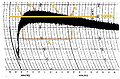
The Farinograph works by simulating the process of dough formation. A small sample of flour is mixed with water in a bowl, and the resistance of the dough to the mixing action is measured. This resistance, or viscosity, is plotted against time to create a curve known as the Farinograph curve. The characteristics of this curve provide valuable information about the flour's quality and performance.
Interpretation[edit]
Several parameters can be derived from the Farinograph curve, including water absorption, dough development time, dough stability, and degree of softening. These parameters are used to predict how the flour will behave during the baking process.
Applications[edit]
The Farinograph is used in various applications, including flour and dough testing, quality control, and product development. It helps bakers and food scientists to select the right type of flour for a particular product, adjust the water content in the dough, and optimize the mixing process.
See also[edit]

-
 Farinograph
 -
 Farinograph
 -
 Farinograph


Ad. Transform your health with W8MD Weight Loss, Sleep & MedSpa

Tired of being overweight?
Special offer:
Budget GLP-1 weight loss medications
- Semaglutide starting from $29.99/week and up with insurance for visit of $59.99 and up per week self pay.
- Tirzepatide starting from $45.00/week and up (dose dependent) or $69.99/week and up self pay
✔ Same-week appointments, evenings & weekends
Learn more:
- GLP-1 weight loss clinic NYC
- W8MD's NYC medical weight loss
- W8MD Philadelphia GLP-1 shots
- Philadelphia GLP-1 injections
- Affordable GLP-1 shots NYC
- Budget GLP-1 shots
|
WikiMD Medical Encyclopedia |
Medical Disclaimer: WikiMD is for informational purposes only and is not a substitute for professional medical advice. Content may be inaccurate or outdated and should not be used for diagnosis or treatment. Always consult your healthcare provider for medical decisions. Verify information with trusted sources such as CDC.gov and NIH.gov. By using this site, you agree that WikiMD is not liable for any outcomes related to its content. See full disclaimer.
Credits:Most images are courtesy of Wikimedia commons, and templates, categories Wikipedia, licensed under CC BY SA or similar.
Translate this page: - East Asian
中文,
日本,
한국어,
South Asian
हिन्दी,
தமிழ்,
తెలుగు,
Urdu,
ಕನ್ನಡ,
Southeast Asian
Indonesian,
Vietnamese,
Thai,
မြန်မာဘာသာ,
বাংলা
European
español,
Deutsch,
français,
Greek,
português do Brasil,
polski,
română,
русский,
Nederlands,
norsk,
svenska,
suomi,
Italian
Middle Eastern & African
عربى,
Turkish,
Persian,
Hebrew,
Afrikaans,
isiZulu,
Kiswahili,
Other
Bulgarian,
Hungarian,
Czech,
Swedish,
മലയാളം,
मराठी,
ਪੰਜਾਬੀ,
ગુજરાતી,
Portuguese,
Ukrainian
