Tetrahydrocannabivarin
Tetrahydrocannabivarin (THCV) is a compound found in the Cannabis plant. It is one of many cannabinoids present in the plant, and has unique properties that distinguish it from other cannabinoids such as THC and CBD.
Chemistry[edit]
THCV is a homologue of THC, but with a propyl (3-carbon) side chain instead of a pentyl (5-carbon) group on the molecule, which makes it produce very different effects from THC. It is a pale yellow resin or crystal with a melting point of 220-225 °C and a boiling point of 428 °F (220 °C).
Pharmacology[edit]
THCV has been found to be a CB1 receptor antagonist, unlike THC which is a CB1 agonist. This means that it can reduce the effects of THC. However, at higher doses, THCV has been found to act as a CB1 agonist, similar to THC. It is also a CB2 receptor partial agonist, which may give it potential therapeutic roles in the treatment of inflammation and pain.
Medical uses[edit]
Research into the medical uses of THCV is still in its early stages. However, preliminary studies suggest that it may have potential in the treatment of obesity-associated glucose intolerance. It has also been suggested that THCV could be used in the treatment of Parkinson's disease, as it has been shown to have neuroprotective effects.
Legal status[edit]
The legal status of THCV varies by country and often depends on its source. In many jurisdictions, it is legal if it is derived from hemp, but illegal if it is derived from other strains of cannabis.
See also[edit]


-
 Tetrahydrocannabivarin chemical structure
 -
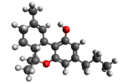 Tetrahydrocannabivarin molecule
 -
 Delta-8-Tetrahydrocannabivarin structure


Ad. Transform your life with W8MD's
GLP-1 weight loss injections special from $29.99 with insurance
|
WikiMD Medical Encyclopedia |
Medical Disclaimer: WikiMD is for informational purposes only and is not a substitute for professional medical advice. Content may be inaccurate or outdated and should not be used for diagnosis or treatment. Always consult your healthcare provider for medical decisions. Verify information with trusted sources such as CDC.gov and NIH.gov. By using this site, you agree that WikiMD is not liable for any outcomes related to its content. See full disclaimer.
Credits:Most images are courtesy of Wikimedia commons, and templates, categories Wikipedia, licensed under CC BY SA or similar.
Translate this page: - East Asian
中文,
日本,
한국어,
South Asian
हिन्दी,
தமிழ்,
తెలుగు,
Urdu,
ಕನ್ನಡ,
Southeast Asian
Indonesian,
Vietnamese,
Thai,
မြန်မာဘာသာ,
বাংলা
European
español,
Deutsch,
français,
Greek,
português do Brasil,
polski,
română,
русский,
Nederlands,
norsk,
svenska,
suomi,
Italian
Middle Eastern & African
عربى,
Turkish,
Persian,
Hebrew,
Afrikaans,
isiZulu,
Kiswahili,
Other
Bulgarian,
Hungarian,
Czech,
Swedish,
മലയാളം,
मराठी,
ਪੰਜਾਬੀ,
ગુજરાતી,
Portuguese,
Ukrainian
