Lead(II,IV) oxide
Lead(II,IV) oxide, also known as minium, is a chemical compound with the formula Pb_3O_4. It is a mixed oxide where lead is present in both the +2 and +4 oxidation states. This bright red or orange pigment has been used historically in paints and is also known by the name red lead. Lead(II,IV) oxide is an important material in the lead-acid battery and in various rust-proofing formulations. Despite its utility, the toxicity of lead compounds has led to a decline in its use.
Properties[edit]
Lead(II,IV) oxide is a red or orange crystalline solid that is insoluble in water. It has a tetragonal crystal structure. The compound is made up of Pb^2+ and Pb^4+ ions, along with O^2− ions, forming a complex crystal lattice. It is thermally stable up to high temperatures but decomposes upon heating in air, giving off toxic lead(II) oxide fumes.
Synthesis[edit]
Lead(II,IV) oxide can be synthesized by several methods. One common method involves the controlled oxidation of lead(II) oxide (PbO) in air at temperatures between 450°C to 480°C. Another method is the thermal decomposition of lead(II) nitrate (Pb(NO_3)_2) or lead(II) carbonate (PbCO_3) at high temperatures, which also results in the formation of lead(II,IV) oxide.
Applications[edit]
Historically, lead(II,IV) oxide has been used as a pigment in red paints and as a rust inhibitor. In the modern era, its most significant application is in the manufacture of lead-acid batteries, where it plays a crucial role in the electrodes. It is also used in the glass and ceramic industries to improve the properties of the final products.
Health and Environmental Concerns[edit]
Lead(II,IV) oxide is toxic, capable of causing lead poisoning if ingested or inhaled. Lead poisoning can result in serious health issues, including damage to the nervous system, kidney problems, and developmental issues in children. Due to these concerns, the use of lead-based compounds, including lead(II,IV) oxide, has been significantly restricted in many countries.
Regulation and Safety[edit]
Handling of lead(II,IV) oxide requires strict safety measures. Personal protective equipment (PPE), such as gloves and respirators, is essential to minimize exposure. Environmental regulations also govern the disposal of lead-containing waste to prevent contamination of soil and water.
See Also[edit]

-
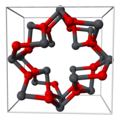 Lead(II,IV) oxide unit cell
 -
 Lead(II,IV) oxide 3D structure
 -
 Lead(II,IV) oxide


Ad. Transform your life with W8MD's
GLP-1 weight loss injections special from $29.99 with insurance
|
WikiMD Medical Encyclopedia |
Medical Disclaimer: WikiMD is for informational purposes only and is not a substitute for professional medical advice. Content may be inaccurate or outdated and should not be used for diagnosis or treatment. Always consult your healthcare provider for medical decisions. Verify information with trusted sources such as CDC.gov and NIH.gov. By using this site, you agree that WikiMD is not liable for any outcomes related to its content. See full disclaimer.
Credits:Most images are courtesy of Wikimedia commons, and templates, categories Wikipedia, licensed under CC BY SA or similar.
Translate this page: - East Asian
中文,
日本,
한국어,
South Asian
हिन्दी,
தமிழ்,
తెలుగు,
Urdu,
ಕನ್ನಡ,
Southeast Asian
Indonesian,
Vietnamese,
Thai,
မြန်မာဘာသာ,
বাংলা
European
español,
Deutsch,
français,
Greek,
português do Brasil,
polski,
română,
русский,
Nederlands,
norsk,
svenska,
suomi,
Italian
Middle Eastern & African
عربى,
Turkish,
Persian,
Hebrew,
Afrikaans,
isiZulu,
Kiswahili,
Other
Bulgarian,
Hungarian,
Czech,
Swedish,
മലയാളം,
मराठी,
ਪੰਜਾਬੀ,
ગુજરાતી,
Portuguese,
Ukrainian
