Echium plantagineum
Echium plantagineum, commonly known as Paterson's curse, salvation Jane, purple viper's-bugloss, or lady Campbell's weed, is a species of flowering plant in the boraginaceae family. Native to western and southern Europe and western Asia, it has been introduced to Australia, South Africa, and the United States, where it is often considered an invasive species. The plant is notable for its striking purple flowers and its ability to thrive in a variety of soil types, although it prefers disturbed sites.
Description[edit]
Echium plantagineum is a biennial or short-lived perennial plant that can grow up to 60-70 cm in height. Its leaves are lanceolate to elliptical, rough in texture, and covered with small hairs. The plant produces dense spikes of deep purple to blue flowers, each with a protruding stamen, which bloom from late spring to summer. The fruit is a nutlet, containing seeds that can remain viable in the soil for several years.
Habitat and Distribution[edit]
Originally from the Mediterranean region, Echium plantagineum has spread to many parts of the world. In its native habitat, it is found in open fields, meadows, and along roadsides. As an invasive species, it has colonized similar habitats in other regions, particularly in Australia, where it poses a significant threat to agricultural lands and native ecosystems.
Ecological Impact[edit]
In areas where it has been introduced, Echium plantagineum can form dense stands that outcompete native vegetation, reducing biodiversity. It is particularly problematic in pasturelands, where it can take over and reduce the available forage for livestock. Additionally, the plant contains pyrrolizidine alkaloids, which are toxic to livestock, especially horses and cattle, leading to liver damage and potentially death if ingested in large quantities.
Control and Management[edit]
Managing Echium plantagineum infestations involves a combination of mechanical, chemical, and biological methods. Mechanical control includes plowing and mowing before the plant sets seed. Chemical control involves the use of herbicides, although care must be taken to avoid damage to native species and water sources. Biological control has also been explored, with the introduction of specific moth and weevil species that feed on the plant, although these methods require careful monitoring to avoid unintended ecological impacts.
Uses[edit]
Despite its status as a weed, Echium plantagineum has some beneficial uses. The plant is a source of nectar for bees and other pollinators. Additionally, it has been used in traditional medicine for its purported anti-inflammatory and analgesic properties, although scientific evidence supporting these uses is limited.
See Also[edit]
References[edit]
<references/>

-
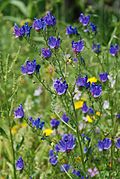 Echium plantagineum
 -
 Echium plantagineum flowers


Ad. Transform your health with W8MD Weight Loss, Sleep & MedSpa

Tired of being overweight?
Special offer:
Budget GLP-1 weight loss medications
- Semaglutide starting from $29.99/week and up with insurance for visit of $59.99 and up per week self pay.
- Tirzepatide starting from $45.00/week and up (dose dependent) or $69.99/week and up self pay
✔ Same-week appointments, evenings & weekends
Learn more:
- GLP-1 weight loss clinic NYC
- W8MD's NYC medical weight loss
- W8MD Philadelphia GLP-1 shots
- Philadelphia GLP-1 injections
- Affordable GLP-1 shots NYC
|
WikiMD Medical Encyclopedia |
Medical Disclaimer: WikiMD is for informational purposes only and is not a substitute for professional medical advice. Content may be inaccurate or outdated and should not be used for diagnosis or treatment. Always consult your healthcare provider for medical decisions. Verify information with trusted sources such as CDC.gov and NIH.gov. By using this site, you agree that WikiMD is not liable for any outcomes related to its content. See full disclaimer.
Credits:Most images are courtesy of Wikimedia commons, and templates, categories Wikipedia, licensed under CC BY SA or similar.
Translate this page: - East Asian
中文,
日本,
한국어,
South Asian
हिन्दी,
தமிழ்,
తెలుగు,
Urdu,
ಕನ್ನಡ,
Southeast Asian
Indonesian,
Vietnamese,
Thai,
မြန်မာဘာသာ,
বাংলা
European
español,
Deutsch,
français,
Greek,
português do Brasil,
polski,
română,
русский,
Nederlands,
norsk,
svenska,
suomi,
Italian
Middle Eastern & African
عربى,
Turkish,
Persian,
Hebrew,
Afrikaans,
isiZulu,
Kiswahili,
Other
Bulgarian,
Hungarian,
Czech,
Swedish,
മലയാളം,
मराठी,
ਪੰਜਾਬੀ,
ગુજરાતી,
Portuguese,
Ukrainian
